If you’ve been powering your Arduino or ESP32 projects from a USB port or a random wall adapter, you already know the frustration: inconsistent voltage, no current limiting, and zero visibility into what your circuit is actually drawing. A proper bench power supply fixes all of that. It gives you adjustable voltage, adjustable current limiting, and a live readout of exactly what’s happening, which makes debugging circuits dramatically easier and protects your components when something goes wrong.
For Arduino and ESP32 work specifically, you don’t need anything exotic. Most projects run at 3.3V or 5V and draw well under 2A. But having the headroom to go up to 30V matters when you start adding motors, servos, relay modules, or LED strips. Current limiting is the feature that really earns its keep: set it just above your expected draw and the supply will cut power before a wiring mistake destroys your microcontroller or sensor.
This is the kind of tool that changes how you work. Once you have one on the bench, you’ll wonder how you managed without it.
If you’re building out your workbench, also check out our guides to the Best Oscilloscopes for Beginners and the Best Multimeters for Electronics Beginners on ComponentAdvisor.
Quick Comparison Table
| Product | Type | Voltage Range | Max Current | Best For | Price Range |
|---|---|---|---|---|---|
| Hanmatek HM310 | Switching | 0-30V | 10A | Best overall / first bench PSU | ~$65-70 |
| Jesverty SPS-3010 | Switching | 0-30V | 10A | Best budget pick | ~$45-55 |
| KORAD KD3005D | Linear | 0-30V | 5A | Best for noise-sensitive work | ~$125-140 |
| Longwei LW-K3010D | Switching | 0-30V | 10A | Best value with 10A headroom | ~$40-50 |
| KORAD KA3005P | Linear | 0-30V | 5A | Best programmable / PC control | ~$140-160 |
1. Best Overall Bench Power Supply for Hobbyists
Hanmatek HM310
Best for: First bench power supply, general Arduino and ESP32 prototyping, anyone who wants solid specs without overpaying.
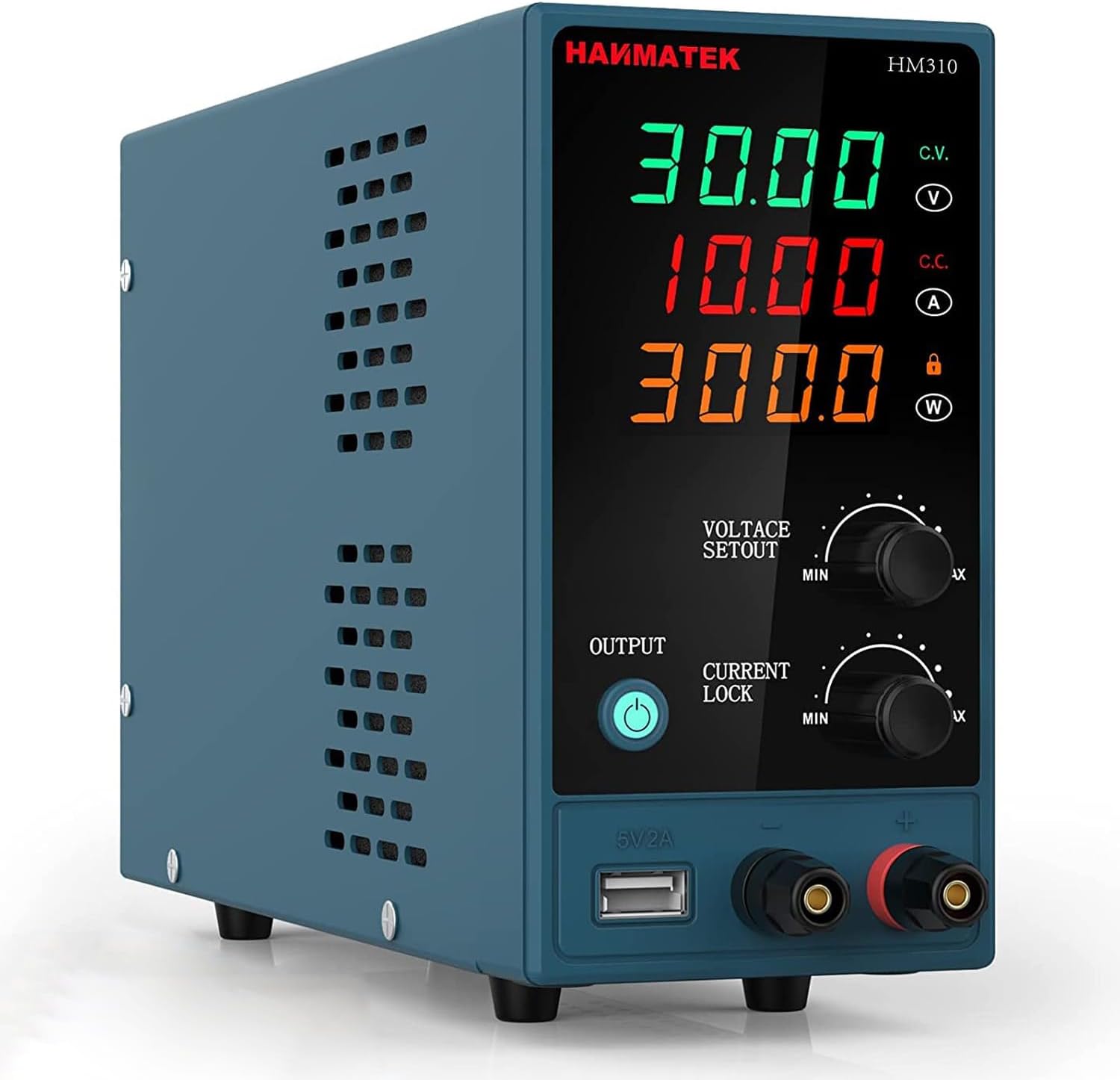
The Hanmatek HM310 keeps showing up on hobbyist workbenches for a good reason: it delivers 30V at up to 10A in a compact, no-nonsense package at a price that doesn’t sting. For the vast majority of Arduino and ESP32 projects, 10A is far more than you’ll ever pull, but having that ceiling means the supply won’t sweat when you’re running a motor driver, a 12V relay board, and a microcontroller at the same time.
It’s a switching supply, which means it’s lighter and more efficient than a linear unit. For digital projects, that’s a non-issue. If you’re working with analog sensors or audio circuits, switching supplies can introduce a small amount of noise, but the HM310’s ripple is low enough that most hobbyists will never encounter a problem with it.
The front panel is clean and readable: two bright LED displays showing voltage and current simultaneously, coarse and fine adjustment knobs for both, and a USB port on the front that puts out a fixed 5V. That USB port is a surprisingly useful touch for charging your phone or powering a secondary device while your main circuit is connected to the binding posts.
Specifications:
- Output voltage: 0-30V continuously adjustable
- Output current: 0-10A continuously adjustable
- Display resolution: 0.01V / 0.001A
- USB output: 5V / 2A
- Protection: OVP, OCP, OTP, short circuit
- Dimensions: approximately 8.5 x 3.5 x 6.3 inches
Why it stands out:
- 10A output covers motors, servos, and multi-module setups without any stress
- Compact footprint for a full-featured bench supply
- Front USB port is a genuinely useful bonus
- Fine and coarse knobs give precise control without fiddling
Things to keep in mind:
- Switching supply: not ideal for RF or audio work where ultra-clean power matters
- Fan can be audible under heavy load
- Included test leads are basic and worth upgrading if you plan to draw high current
👉 Buy Hanmatek HM310 on Amazon
Verdict: This is the one to get if you want a reliable all-rounder that handles everything from powering a bare ESP32 at 3.3V to running a 12V stepper motor setup. Good build, good specs, sensible price.
2. Best Budget Bench Power Supply
Jesverty SPS-3010
Best for: Beginners who want a capable first supply without spending much, light prototyping, learning how bench supplies work.

The Jesverty SPS-3010 is one of the better entry-level options in this category. You get 30V and 10A adjustable output with a 4-digit display showing voltage, current, and wattage in real time. For the price, that’s a capable feature set.
The SPS-3010 runs in both constant voltage (CV) and constant current (CC) mode, switching automatically depending on what the load demands. That auto-switching matters for Arduino and ESP32 work: set your current limit just above your expected draw, and if a wiring mistake causes a short, the supply drops into CC mode and limits current instead of frying your board. It’s the safety net that USB ports and wall adapters simply don’t provide.
The enclosure is metal and reasonably solid for the price. The temperature-controlled fan is quiet under light load, only ramping up when things heat up, which is a detail you appreciate in a home lab. One thing worth knowing: the supply does not immediately energize the output when powered on, which is actually a safety feature, not a flaw.
Specifications:
- Output voltage: 0-30V continuously adjustable
- Output current: 0-10A continuously adjustable
- Display: 4-digit LED, shows V / A / W
- Display resolution: 0.01V / 0.001A / 0.1W
- USB output: 5V / 2A
- Protection: short circuit, overload, thermal, OVP
- Dimensions: 7.1 x 3.35 x 6.1 inches, approx. 2.5 lbs
Why it stands out:
- Shows wattage on the display, useful for power budget calculations
- Very compact and lightweight for a 30V/10A supply
- Auto CV/CC switching works reliably
- Includes a 110V/220V selector for international use
Things to keep in mind:
- Switching supply: not for noise-sensitive analog or audio work
- Included test leads are thin and not rated for high sustained current
- At this price point, build consistency can vary between units
👉 Buy Jesverty SPS-3010 on Amazon
Verdict: A solid entry point. If you’re new to bench supplies and want to try one without a big investment, the SPS-3010 covers all the basics and will handle Arduino and ESP32 work without issues.
3. Best Linear Bench Power Supply
KORAD KD3005D
Best for: Analog circuits, sensors, audio projects, anyone who needs the cleanest possible output voltage.
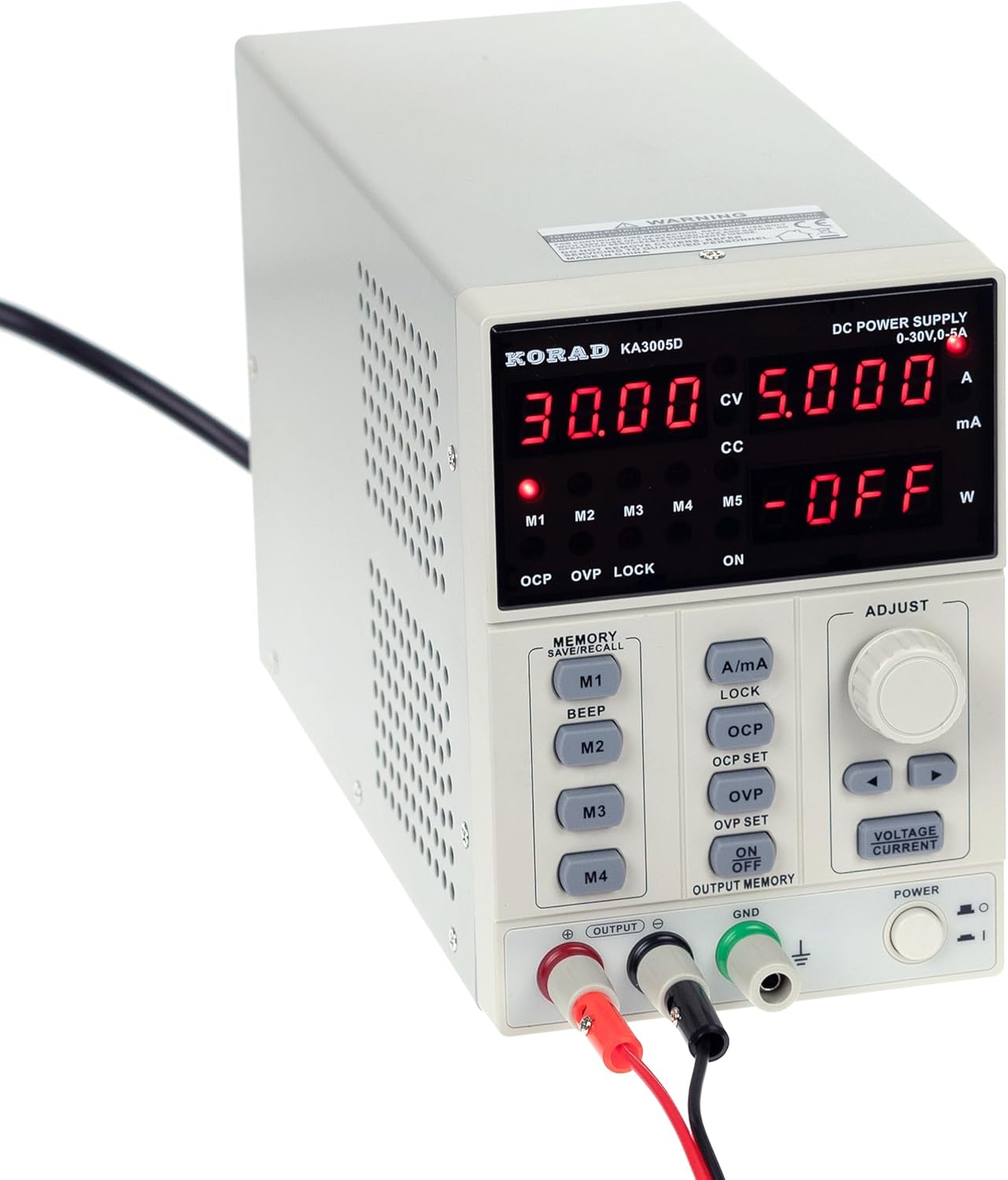
The KORAD KD3005D is a linear regulated supply, which puts it in a different category from the switching units above. Linear supplies work by dissipating excess voltage as heat rather than switching rapidly to regulate output. The result is dramatically lower ripple and noise on the output, which matters the moment you’re working with analog sensors, audio amplifiers, or any circuit that’s sensitive to fluctuations on the supply rail.
For a concrete example: if you’re using an INA219 current sensor or an ADS1115 ADC with your ESP32, a noisy supply can produce jittery readings that look like sensor errors. Swap in a clean linear supply and the noise floor drops. That kind of difference is hard to appreciate until you’ve experienced it firsthand.
The KD3005D is rated at 30V and 5A, which covers the large majority of Arduino and ESP32 hobby work. The 4-digit LED display gives accurate readings, and the coarse and fine adjustment knobs make it easy to dial in a precise voltage. KORAD has a long reputation in the hobbyist and maker community for building supplies that hold their calibration and don’t develop quirks over time. This is a supply that should last you a decade of regular bench use.
Specifications:
- Output voltage: 0-30V continuously adjustable
- Output current: 0-5A continuously adjustable
- Regulation type: linear
- Display: 4-digit LED, voltage and current
- Display resolution: 0.01V / 0.001A
- Protection: OVP, OCP, OTP, short circuit
- Weight: approximately 4 kg (heavier than switching units, normal for linear)
Why it stands out:
- Linear regulation means extremely low ripple: ideal for analog and audio work
- KORAD’s build quality and component reliability are consistently well-regarded
- Temperature-controlled rear fan keeps it quiet under light loads
- Solid choice for long-term bench use
Things to keep in mind:
- Heavier and larger than switching supplies of equivalent rating (expected for linear design)
- 5A maximum current is lower than switching alternatives at similar prices
- Runs warmer than a switching supply, normal for linear design
Verdict: If you’re doing any analog sensor work, audio, or RF projects alongside your microcontroller builds, this is the supply to get. The clean output is worth the size and weight tradeoff.
4. Best Bench Power Supply for High-Current Projects
Longwei LW-K3010D
Best for: Motor-heavy projects, multiple loads at once, anyone running servos, steppers, or 12V accessories from their Arduino or ESP32.

The Longwei LW-K3010D sits in a practical middle ground: more current headroom than most hobbyists will ever need, at a price that’s easy to justify. The 30V/10A switching supply format is familiar territory, but Longwei’s implementation has a few things going for it, including a backlit 3-digit display that’s easy to read across the bench and a build that feels more substantial than the budget tier.
Where this supply earns its slot in the lineup is current capacity combined with price. If you’re running an Arduino project with multiple servo motors, a 12V motor driver board, or a larger LED matrix, having 10A available means you can power the entire rig from one supply without worrying about headroom. You can also use it to simulate battery conditions by dialing in the exact voltage a battery pack would deliver, which is useful for testing how your code handles low-power conditions.
The protection suite is complete: overvoltage, overcurrent, over-temperature, and short circuit protection are all present. The intelligent temperature fan reduces noise during low-load sessions, which is appreciated when you’re spending hours on a project.
Specifications:
- Output voltage: 0-30V continuously adjustable
- Output current: 0-10A continuously adjustable
- Display: backlit 3-digit LED, shows V and A
- Display resolution: 0.1V / 0.01A
- Protection: OVP, OCP, OTP, short circuit, grounding
- Cooling: intelligent temperature-controlled fan
Why it stands out:
- 10A capacity handles motor and multi-load projects comfortably
- Backlit display is easy to read in varied lighting conditions
- Complete protection suite for safe bench use
- Good build quality relative to price point
Things to keep in mind:
- 3-digit display (0.1V resolution on voltage) is less precise than 4-digit alternatives
- Switching supply: same noise caveats as other switching units
- Heavier than the Jesverty at similar specs
👉 Buy Longwei LW-K3010D on Amazon
Verdict: A dependable workhorse for projects that pull serious current. If your Arduino or ESP32 builds involve motors or multiple power rails, the Longwei gives you the headroom to handle it all without compromise.
5. Best Programmable Bench Power Supply
KORAD KA3005P
Best for: Repeatable test setups, data logging, automated testing, anyone who wants PC control over their power supply.

The KORAD KA3005P is the programmable version of KORAD’s well-regarded linear supply line. The key additions over the standard KD3005D are four memory preset buttons and a USB port on the rear that connects to a PC, letting you control voltage and current settings, monitor output in real time, and log data directly from your computer.
For most hobbyists, the memory presets alone are worth the price difference. If you regularly switch between 3.3V for ESP32 work, 5V for Arduino, and 12V for motor testing, you can store each of those configurations and switch between them with a single button press instead of re-dialing every time. It’s a small quality-of-life improvement that adds up over a long build session.
The PC software opens up more interesting possibilities. You can write scripts to automate voltage sweeps, log current draw over time while your code runs different routines, or run automated test sequences on a batch of boards. That’s more of a professional workflow, but even for hobbyists, being able to graph current draw over time while debugging power consumption on an ESP32 sleep cycle is genuinely useful.
The linear regulation carries over from the KD3005D, so output quality is excellent: low ripple, stable voltage under varying loads, and the same KORAD build reliability the hobbyist community has trusted for years.
Specifications:
- Output voltage: 0-30V continuously adjustable
- Output current: 0-5A continuously adjustable
- Regulation type: linear
- Display resolution: 0.001V / 0.001A (highest resolution in this lineup)
- Memory presets: 4 programmable slots
- PC connectivity: USB (rear panel)
- Protection: OVP, OCP, OTP, short circuit
Why it stands out:
- Four memory presets make switching between common voltages fast
- PC control and data logging via included software
- 0.001V display resolution is the best in this roundup
- Linear regulation: clean output for analog and sensitive circuits
Things to keep in mind:
- Highest price in the lineup; only worth it if you’ll use the programmable features
- PC software is functional but not polished
- 5A max current; not for high-current motor projects
Verdict: If you’re doing any kind of systematic testing, power consumption profiling on your ESP32 projects, or just want the convenience of memory presets, the KA3005P justifies the premium. Otherwise, the KD3005D gives you the same linear quality for less.
Which Bench Power Supply Should You Buy?
The right choice depends almost entirely on what you’re building.
If you’re just getting started and want a reliable supply for general Arduino and ESP32 work, the Hanmatek HM310 is the obvious choice. It covers everything, has 10A of headroom for future projects, and doesn’t ask you to make any compromises for the price. It’s the pick for most people reading this.
If you’re on a tighter budget and your projects are straightforward, the Jesverty SPS-3010 does the job. It’s more basic in feel but covers the fundamentals and won’t let you down for standard microcontroller work.
If you’re working with analog sensors, INA219 current monitors, ADC modules, audio circuits, or anything where supply noise could affect readings, go with the KORAD KD3005D. The linear regulation makes a real difference in those scenarios, and KORAD’s reliability means you’re buying something that will still be on your bench in ten years.
If your projects involve motors, servo arrays, 12V accessories, or multiple simultaneous loads, the Longwei LW-K3010D is the better pick over the Hanmatek simply because of its display and build at a comparable price point.
If you’re building a more serious test setup, doing power profiling on battery-powered ESP32 projects, or want the ability to script and automate your bench, the KORAD KA3005P is worth every bit of the premium.
How to Use a Bench Power Supply with Arduino and ESP32
Using a bench supply with a microcontroller is simple, but a couple of habits will protect your hardware.
Always set your current limit before connecting your circuit. For a bare Arduino Uno, start at 500mA. For an ESP32 with WiFi active, set it around 700-800mA to account for transmission spikes. If your supply immediately drops into current-limiting mode when you connect your board, something is wrong before you’ve had a chance to damage anything.
For Arduino boards with a barrel jack, you can power them directly from the supply at 7-12V and let the onboard regulator handle the rest. For ESP32 development boards, either use the USB port on the supply to power via a cable, or connect directly to the 3.3V pin if you want to bypass the onboard regulator entirely. Just don’t exceed 3.3V on that pin.
For more on getting started with ESP32 power and project setup, check out the tutorials on ArduinoYard, including their ESP32 getting started guide and Arduino project tutorials for practical wiring examples.
Alligator clips on banana plugs are fine for quick tests. For anything more permanent during development, get a pair of proper bench leads with 4mm banana plugs and tinned wire ends. The leads that come with most of these supplies are undersized for high-current work.
Final Recommendation
For most Arduino and ESP32 hobbyists, the Hanmatek HM310 is the one to buy. It handles the full range of typical projects, has enough current for future work with motors and multi-module builds, and hits a price point that’s easy to justify. If you know your work involves analog sensors, audio, or RF, go straight to the KORAD KD3005D instead: the clean linear output is worth the size.
Either way, a bench power supply is one of those tools that immediately changes how you work. You’ll wonder why you waited.
Also on ComponentAdvisor: Best Oscilloscopes for Beginners | Best Multimeters for Electronics Beginners | Best Soldering Kits for Beginners
1 thought on “Best Bench Power Supply for Arduino and ESP32 Projects”