The best electronics learning kit does more than hand you a bag of components. It gives you a structured path from your first blinking LED to building real projects you actually care about, without leaving you stuck on page three of a confusing PDF. The kits in this roundup cover the strongest options available right now, from Raspberry Pi-based platforms to ESP32 camera builds, beginner Arduino setups with serious tutorial depth, and the official kit that works best as a gift or for classroom use.
This guide is intentionally broader than a standard Arduino starter kit comparison. The best electronics learning kits let you grow: this roundup covers kits based on the Mega 2560 for projects that outgrow the UNO, cross-platform sensor kits that work with Arduino, Raspberry Pi, and ESP32 simultaneously, and a premium robotics kit for anyone who wants to build something that actually moves.
Already working through a kit and want to know what to build first? ArduinoYard’s Getting Started with Arduino guide is the right place to begin, and the beginner’s guide to PCB soldering is worth bookmarking for when you are ready to move off the breadboard.
Looking for the board itself rather than a full kit? Our guides on the Best Raspberry Pi Boards and Best ESP32 Development Boards cover standalone hardware options.
Quick Comparison Table
| Kit | Platform | Projects | Tutorial Format | Best For |
|---|---|---|---|---|
| Freenove Ultimate Starter Kit (Raspberry Pi) | Raspberry Pi 4/5 | 128 projects | 962-page PDF | Best Pi-based learning kit |
| SunFounder 3-in-1 Ultimate Starter Kit | Arduino UNO | 87 projects | Online video + text | Best 3-in-1 coverage |
| ELEGOO MEGA 2560 Most Complete Starter Kit | Arduino Mega 2560 | 50+ projects | PDF tutorial | Best upgrade from UNO |
| Freenove ESP32 Starter Kit (WROVER + camera) | ESP32 WROVER | 122 projects | 795-page PDF | Best ESP32 learning kit |
| SunFounder Universal Maker Sensor Kit | Arduino/Pi/ESP32/Pico | 40+ projects | Online | Best cross-platform kit |
| Official Arduino Starter Kit R4 (K000007_R4) | Arduino UNO R4 WiFi | 13 projects | Printed book | Best official/gift kit |
| Makeblock mBot Ranger 3-in-1 | Arduino Mega (Auriga) | 3 robot configs | App + online | Best robotics learning kit |
1. Best Raspberry Pi Learning Kit: Freenove Ultimate Starter Kit for Raspberry Pi
Freenove Ultimate Starter Kit for Raspberry Pi 5 / 4B
Best for: Learners who want to build on Raspberry Pi with the most thorough tutorial documentation available in any maker kit.

Freenove’s Ultimate Starter Kit for Raspberry Pi has a legitimate claim to being the best-documented beginner kit on the market, regardless of platform. The tutorial PDF runs to 962 pages, covers 128 projects across Python, C, Java, and Scratch, and explains each circuit at the component level rather than just saying “connect this wire here.” It is the kind of documentation that turns a kit into an actual course.
The kit includes 223 components: breadboards, jumper wires, LEDs, resistors, capacitors, sensors including a DHT11, ultrasonic, IR, and PIR, a servo motor, stepper motor with driver, relay module, an RFID reader with card and tag, LCD1602 with I2C adapter, and an active and passive buzzer, among others. The Raspberry Pi board itself is not included, but the kit is confirmed compatible with Pi 5, 4B, 3B+, 3B, and Zero 2 W. Freenove also provides free technical support via GitHub and email, which is more than most kit manufacturers offer at any price.
Specifications:
- Platform: Raspberry Pi 5 / 4B / 3B+ / 3B / Zero 2 W (board not included)
- Components: 223 items across 69 types
- Projects: 128 guided projects
- Tutorial: 962-page downloadable PDF
- Languages: Python, C, Java, Scratch
- Support: Free via GitHub and email
Why it stands out:
- 962-page tutorial is the most detailed documentation in any kit at this price tier
- 128 projects cover a genuine progression from basic GPIO control to computer vision and game projects
- Multi-language support lets you learn Python first and explore C or Java later without buying a new kit
- RFID reader, stepper motor, and LCD display included, components that most kits charge extra for
- Free ongoing technical support from Freenove, with updated tutorials as Pi OS changes
Things to keep in mind:
- Raspberry Pi board not included: budget separately for a Pi 4B or Pi 5
- PDF tutorial requires a screen to read alongside the build, which is less convenient than a printed book
- Pi-based projects require more initial setup (OS install, SSH or monitor) than Arduino kits
👉 Buy Freenove Ultimate Starter Kit for Raspberry Pi on Amazon
Verdict: The go-to kit for anyone learning on Raspberry Pi. The tutorial depth alone justifies the purchase. If you are going to invest in a Pi and want structured learning to go with it, this is the kit to pair it with.
2. Best 3-in-1 Arduino Kit: SunFounder 3-in-1 Ultimate Starter Kit
SunFounder 3-in-1 Ultimate Starter Kit for Arduino (IoT + Smart Car + Basic)
Best for: Beginners who want a single kit that covers basic electronics, IoT connectivity, and a working robot car without buying three separate kits.
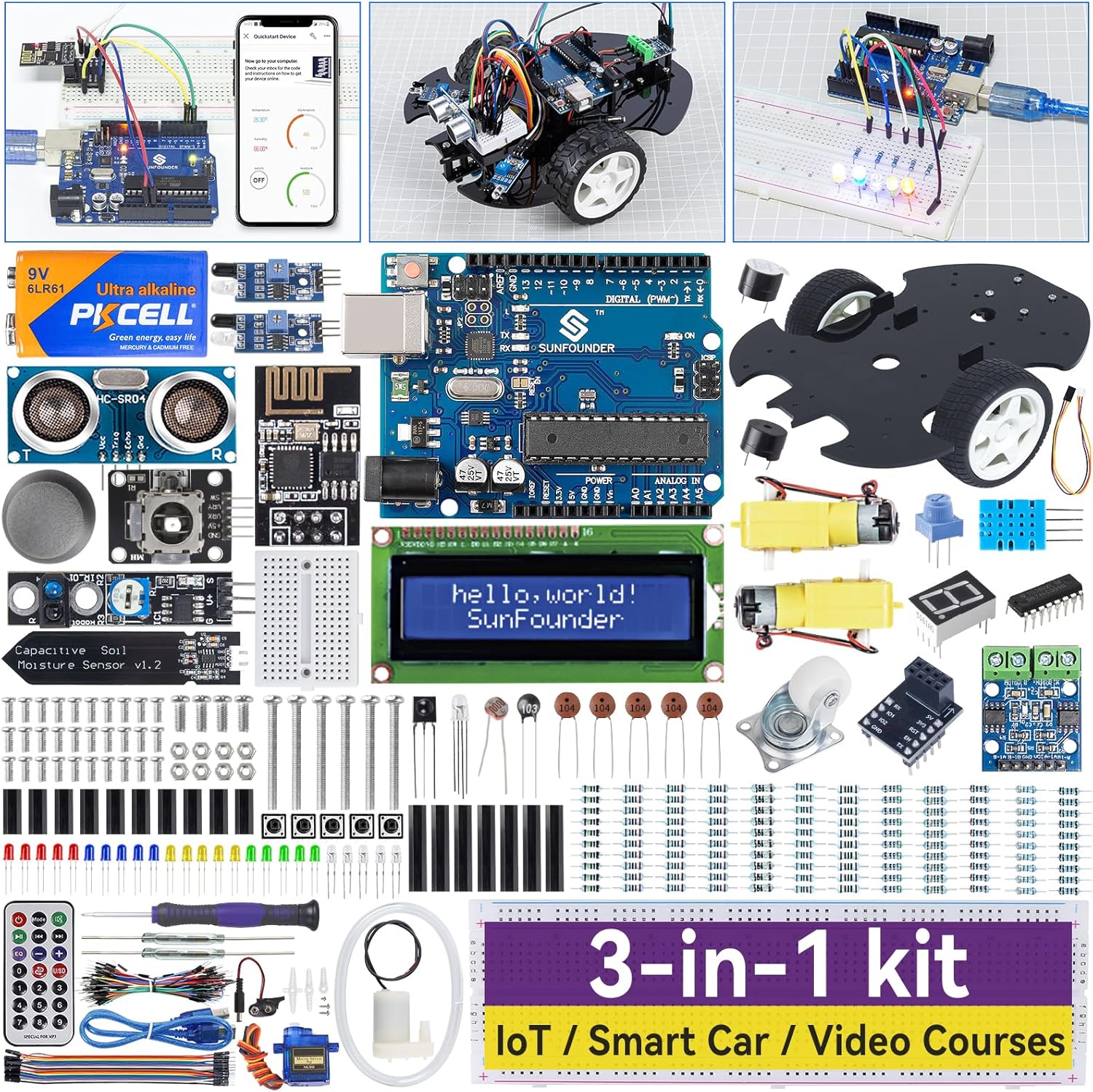
The SunFounder 3-in-1 kit is structured around three distinct learning phases. The first covers basic electronics: sensors, LEDs, a servo, and breadboard fundamentals. The second introduces IoT concepts using an included ESP8266 WiFi module, with projects covering web servers, cloud data sending, and remote control over a local network. The third phase assembles a smart car chassis using the components already learned: line tracking, obstacle avoidance, and Bluetooth control. Each phase builds on the last, and the result is a kit that keeps you occupied for several weeks rather than a few evenings.
SunFounder partnered with Circuit Basics for the tutorial content, which means the documentation quality is a step above what most third-party kits manage. The online platform includes video walkthroughs and written code explanations, and the kit supports both Scratch-based and C++ programming, making it usable from age 8 up through adult learners.
Specifications:
- Platform: Arduino UNO compatible (included)
- Components: 192 items
- Projects: 87 guided projects across three phases
- Connectivity: ESP8266 WiFi module included
- Tutorial: Online video + text (Circuit Basics partnership)
- Programming: Scratch, Arduino C++
Why it stands out:
- Three distinct learning tracks in one kit: basic electronics, IoT, and robotics
- ESP8266 WiFi module included for IoT projects without buying extras
- Smart car chassis assembly bridges the gap between software and physical robotics
- Circuit Basics tutorial partnership delivers above-average video and text documentation
- Supports Scratch coding for younger learners alongside full Arduino C++
Things to keep in mind:
- Online tutorial format requires internet access during build sessions
- IoT section uses ESP8266 rather than the more capable ESP32 found in higher-end kits
- Smart car functionality is more limited than a dedicated robot car kit
👉 Buy SunFounder 3-in-1 Ultimate Starter Kit on Amazon
Verdict: A well-structured kit that delivers on its three-in-one promise. The IoT section covers ground that most beginner Arduino kits skip entirely, and the progression from basic circuits to a working robot car is genuinely satisfying to complete.
3. Best Upgrade Kit: ELEGOO MEGA 2560 Most Complete Starter Kit
ELEGOO MEGA 2560 Project The Most Complete Starter Kit
Best for: Learners who have outgrown an Arduino UNO and need more GPIO pins, more memory, and access to more complex projects.

The Mega 2560 is the natural progression from the UNO for anyone hitting its limits. Where the UNO has 14 digital I/O pins and 32KB of flash, the Mega 2560 has 54 digital I/O pins, 16 analog inputs, and 256KB of flash. That extra capacity matters when you start building projects that combine multiple sensors, displays, motor drivers, and communication modules simultaneously, something the UNO struggles to accommodate without creative pin management.
ELEGOO’s Most Complete Kit for the Mega includes over 200 components: a joystick module, waterproof temperature sensor, prototype PCB for permanent builds, power supply module, and a more comprehensive passive component assortment than their UNO-tier kits. The PDF tutorial covers 63 different component types with dedicated projects for each. ELEGOO’s code is well-commented and compiles cleanly in the Arduino IDE without additional library hunting, which is a meaningful quality-of-life detail for beginners stepping up from a basic kit.
Specifications:
- Platform: Arduino Mega 2560 (ELEGOO clone, included)
- Digital I/O pins: 54
- Analog inputs: 16
- Flash memory: 256KB (8x UNO)
- Components: 200+ items, 63 component types
- Tutorial: Downloadable PDF with code
- Programming: Arduino C++ via Arduino IDE
Why it stands out:
- 54 GPIO pins eliminates the I/O constraints that limit complex UNO projects
- 256KB flash handles longer sketches running multiple libraries simultaneously
- Waterproof DS18B20 temperature sensor included for outdoor or liquid-contact projects
- Prototype PCB included for moving finished projects off the breadboard
- Compatible with all Arduino UNO libraries and shields, just with more room to expand
Things to keep in mind:
- Larger board than UNO, so project enclosures need to account for the extra size
- Overkill for someone who has not yet completed a UNO-based beginner kit
- PDF tutorial only, no video content or online platform
👉 Buy ELEGOO MEGA 2560 Most Complete Starter Kit on Amazon
Verdict: The right next step when a UNO-based kit starts feeling limiting. The extra I/O and memory open up projects that simply are not possible on a UNO, and ELEGOO’s component quality and tutorial clarity are consistent with what their UNO kits deliver.
4. Best ESP32 Learning Kit: Freenove ESP32 Starter Kit (WROVER with Camera)
Freenove ESP32-WROVER CAM Ultimate Starter Kit
Best for: Learners who want to build WiFi, Bluetooth, and camera-enabled projects on ESP32 with the same tutorial depth Freenove brings to their Raspberry Pi kits.

The Freenove ESP32 kit is built around the ESP32-WROVER module with a built-in OV2640 camera, which makes it a completely different kind of learning tool from UNO-based kits. From the first WiFi scan to streaming live camera video from a web browser on your phone, the projects feel more immediately relevant to real-world embedded systems than blinking LEDs on a breadboard. The camera inclusion at this price tier is the standout feature: most ESP32 learning kits treat the camera as an optional add-on.
The 795-page PDF tutorial covers 122 projects in both MicroPython and C, and the progression is well-structured. Early projects cover GPIO basics, then move into analog sensors, PWM, I2C displays, and WiFi modes, before building toward camera web servers, face detection, and TCP/IP socket communication. The dual-language support is practical: start in MicroPython if Python is already familiar, then move to C for performance-critical sketches. ArduinoYard’s ESP32-CAM getting started guide pairs well with this kit for camera-specific projects.
Specifications:
- Platform: ESP32-WROVER (onboard camera, WiFi + Bluetooth)
- Components: 240 items
- Projects: 122 guided projects
- Tutorial: 795-page downloadable PDF
- Languages: MicroPython and C
- Camera: OV2640 (onboard)
- Support: Free via GitHub and email
Why it stands out:
- Built-in OV2640 camera enables web streaming, face detection, and image capture projects out of the box
- 795-page tutorial with 122 projects is the most thorough ESP32 documentation in any kit at this price
- Dual MicroPython and C language support covers both entry-level and more advanced programming
- WiFi and Bluetooth both covered in dedicated project chapters, not just listed as features
- Freenove’s GitHub repository keeps the tutorial updated as the ESP32 Arduino core evolves
Things to keep in mind:
- Requires installing the ESP32 Arduino core, one extra step compared to standard Arduino boards
- Camera projects need a stable WiFi network and a device to view the stream
- MicroPython and C setups require separate tool configurations
👉 Buy Freenove ESP32 WROVER Starter Kit on Amazon
Verdict: The best ESP32 learning kit available. The onboard camera and tutorial depth make it significantly more capable than the alternatives at this price point. If ESP32 and IoT projects are where you are headed, start here.
5. Best Cross-Platform Sensor Kit: SunFounder Universal Maker Sensor Kit
SunFounder Universal Maker Sensor Kit (Arduino / Raspberry Pi / ESP32 / Pico)
Best for: Makers who work across multiple platforms and want a single sensor kit that is compatible with all of them.

Most sensor kits are designed for one platform. The SunFounder Universal kit is designed for four: Arduino Mega/UNO R3/R4, Raspberry Pi 5/4B/3B+/Zero 2 W, Pico W, and ESP32. Each sensor module has documented wiring and code examples for all four platforms, which makes it genuinely useful as a shared resource if you work across more than one board, or if you have not yet decided which platform to settle on.
The kit covers a strong range: temperature, humidity, motion (PIR), ultrasonic, IR, light (LDR), sound, magnetic, touch, tilt, rain, soil moisture, gas, joystick, and OLED display, among others. The tutorial platform supports C++, Python, and MicroPython. It is more of a component library than a structured course, assuming you can already set up a board and install libraries, then providing the sensor-specific code and wiring for each module.
Specifications:
- Compatible platforms: Arduino Mega/UNO R3/R4/Nano, Raspberry Pi 5/4B/3B+/Zero 2 W, Pico W, ESP32
- Sensor types: 40+ sensor and module types
- Programming: C++, Python, MicroPython
- Tutorial: Online (SunFounder platform)
- RoHS compliant
Why it stands out:
- Genuine cross-platform compatibility with documented examples for each board family
- 40+ sensor types covers more variety than any single-platform beginner kit
- Useful as a companion to any existing board, not just as a standalone starter
- Python, C++, and MicroPython all supported, so language choice is flexible
- Good long-term reference: components can be pulled for individual projects as skills develop
Things to keep in mind:
- More of a component library than a structured beginner course
- No board included: assumes you already have a compatible board
- Online tutorial requires internet access and some baseline IDE familiarity
👉 Buy SunFounder Universal Maker Sensor Kit on Amazon
Verdict: The right pick if you already own boards and want a comprehensive sensor library that works across all of them. Not the best entry point for a complete beginner with no board, but an excellent companion kit for active builders.
6. Best Official Kit: Arduino Starter Kit R4 (K000007_R4)
Arduino Starter Kit R4 with UNO R4 WiFi and Printed Projects Book
Best for: Students, educators, and gift buyers who want the genuine Arduino experience with a printed project book and official board.

The official Arduino Starter Kit R4 is a different product from the clone-based kits in this roundup. You are paying for three things: a genuine Arduino UNO R4 WiFi board, a professionally printed 240-page project book produced by Arduino, and an online certification voucher tied to the kit’s curriculum. The component count is lower than ELEGOO or Freenove kits at a similar price, but the quality of the learning materials is higher.
The UNO R4 WiFi uses a 32-bit Renesas RA4M1 core with built-in ESP32-S3 for WiFi and Bluetooth, runs at 48MHz, and has 256KB of flash. The 13 guided projects in the printed book are structured as a proper curriculum, each teaching a specific electronics concept rather than just demonstrating a sensor. The book explains why circuits work, not just how to wire them, and that approach builds understanding rather than just pattern-following. It is the safest kit to buy for a school course or a young person’s first electronics experience.
Specifications:
- Platform: Arduino UNO R4 WiFi (genuine Arduino, included)
- Core: Renesas RA4M1 (32-bit, 48MHz)
- Connectivity: Built-in WiFi + Bluetooth (ESP32-S3)
- Flash: 256KB
- Projects: 13 guided projects
- Tutorial: 240-page printed book + online resources
- Includes: Certification voucher
Why it stands out:
- Genuine Arduino UNO R4 WiFi: not a clone, fully supported by Arduino
- Printed project book is a proper curriculum, better suited to structured learning than PDFs
- Built-in WiFi and Bluetooth on the R4 opens IoT projects without extra modules
- Certification voucher adds value for students and professionals
- Best single kit to buy as a gift or for a classroom setting
Things to keep in mind:
- 13 projects is far fewer than third-party kits, and components are limited to those projects
- Costs more per component than ELEGOO or Freenove alternatives
- Not the best value for pure hobbyist use where clone-based kits cover more ground
👉 Buy Official Arduino Starter Kit R4 on Amazon
Verdict: The best kit to buy as a gift, for classroom use, or for anyone who wants the genuine Arduino experience with a real printed book. Fewer components, but unmatched on the quality of the learning experience it delivers.
7. Best Robotics Learning Kit: Makeblock mBot Ranger 3-in-1
Makeblock mBot Ranger 3-in-1 Programmable Robot Kit
Best for: Learners who want to build physical robots with a premium metal chassis, three different configurations, and a clear path from Scratch coding to Arduino C++.
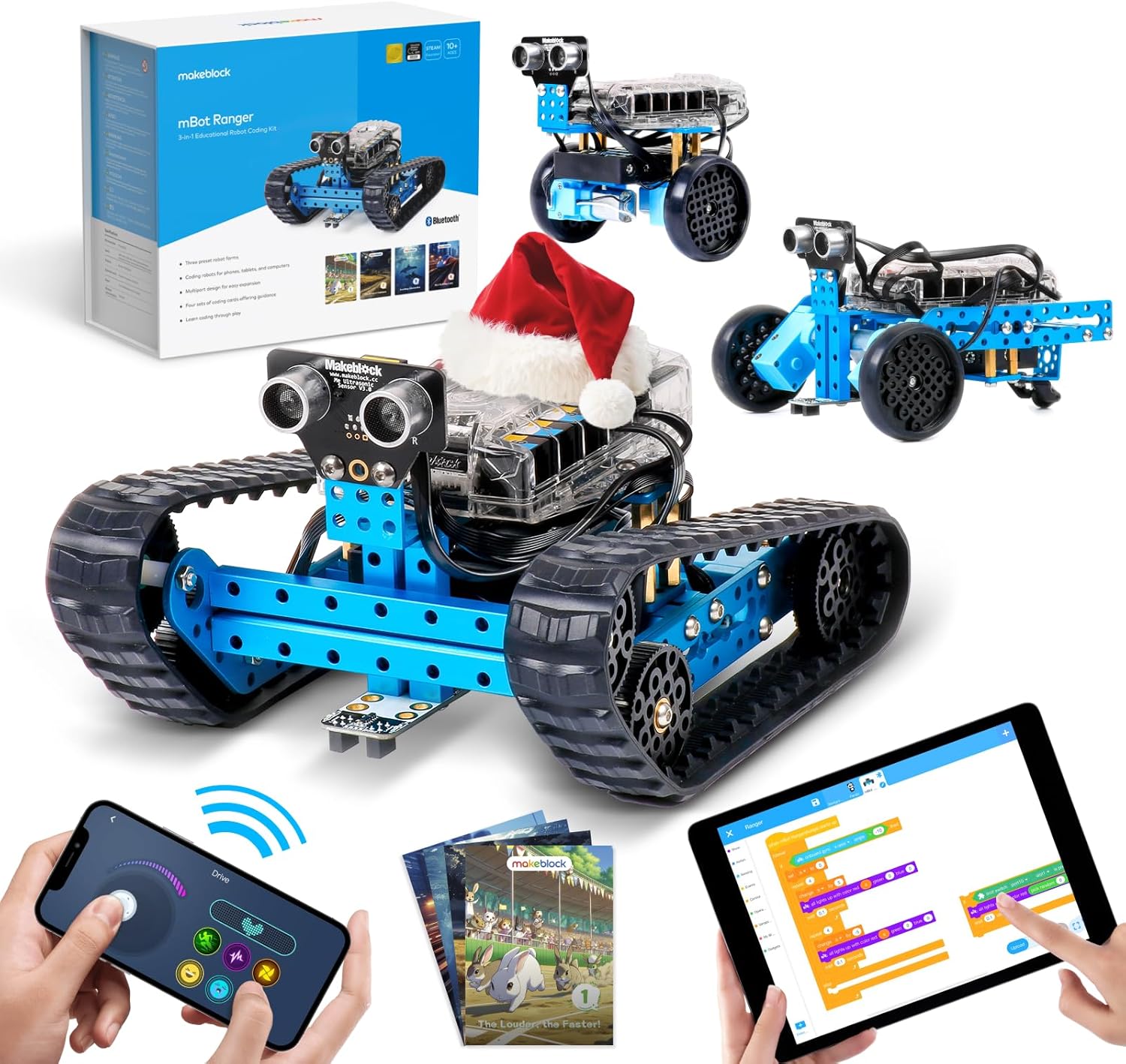
The mBot Ranger is the only kit in this roundup where physical construction is as much a part of the learning as the code. Built from aluminium rather than acrylic or plastic, it ships with enough parts to assemble three distinct robots: a three-wheel self-balancing car, a four-wheel land racer, and a tank-tread crawler. Each configuration has different movement mechanics and sensor setups, so switching between them is a genuinely different engineering challenge each time.
The Me Auriga mainboard is based on the Arduino Mega 2560, with 54 GPIO pins, onboard RGB LEDs, a buzzer, and an onboard gyroscope that makes the self-balancing mode possible. Programming works in mBlock (Scratch-based drag-and-drop) for complete beginners, and transitions cleanly to full Arduino C++ in the Arduino IDE when you are ready. The build quality is the best in this roundup: aluminium construction, precision connectors, and a 43-page instruction booklet with clear diagrams.
Specifications:
- Platform: Me Auriga (Arduino Mega 2560-based)
- Chassis: Aluminium (3-in-1 configurable)
- Configurations: Self-balancing car, land racer, tank crawler
- Sensors: Ultrasonic, line follower, light sensor, onboard gyroscope
- Programming: mBlock (Scratch), Arduino IDE (C++)
- Connectivity: Bluetooth app control
- Extras: Onboard RGB LEDs, buzzer, gyroscope
Why it stands out:
- Three genuinely different robot configurations, each with distinct learning value
- Aluminium construction survives repeated assembly far better than acrylic alternatives
- Mega 2560-based controller has 54 GPIO pins and more flash than UNO-tier boards
- Onboard gyroscope enables self-balancing mode, which introduces PID control concepts
- mBlock to Arduino C++ is one of the cleanest beginner-to-advanced coding progressions available
Things to keep in mind:
- The most expensive kit in this roundup by a significant margin
- More complex assembly than simpler kits
- Bluetooth control only: no WiFi or camera capability
👉 Buy Makeblock mBot Ranger 3-in-1 on Amazon
Verdict: The best premium robotics learning kit. Build quality, three robot configurations, and the Mega-based controller all justify the price for anyone who wants a long-term platform. Particularly strong for learners who want to understand physical robotics alongside programming.
Which Electronics Learning Kit Should You Buy?
The right kit depends on what you want to build and where you are starting from.
For Raspberry Pi, the Freenove Ultimate Starter Kit is the clear answer. Nothing else offers 128 projects and 962 pages of documentation at this price. For a structured three-phase Arduino progression covering basic circuits, IoT, and robotics, the SunFounder 3-in-1 is the most complete single-kit option. If you already have a UNO and are running out of GPIO pins or flash memory, the ELEGOO Mega 2560 Most Complete kit is the logical upgrade.
For ESP32 and connected projects, the Freenove ESP32 WROVER kit stands alone. The onboard camera, 122 projects, and 795-page tutorial make it the most capable ESP32 learning kit available. Pair it with ArduinoYard’s ESP32 deep sleep guide for power-efficient IoT builds.
The SunFounder Universal Sensor Kit is the right buy if you already own multiple boards and want a single sensor library across all of them. The Official Arduino Starter Kit R4 is the pick for gifts, classroom use, or anyone who wants the genuine Arduino brand with a printed project book. The Makeblock mBot Ranger stands apart because it teaches robotics and physical construction alongside programming: if you want a kit that feels like engineering rather than just electronics, this is it.
What to Look for in an Electronics Learning Kit
Component count is easy to compare but documentation quality is what actually matters. A kit with 300 components and a vague quickstart is less useful than one with 150 components and a thorough tutorial that explains why each circuit works. Look for structured project progression, clear wiring diagrams, complete working code, and some form of technical support. Freenove and SunFounder both score well here.
For clone vs official boards: a quality Arduino clone is functionally identical to a genuine board for learning purposes. The same code compiles, the same libraries work, the same pinout applies. ELEGOO and Freenove clones are completely reasonable for personal learning. Official Arduino carries more weight in classroom or gifting contexts.
Platform choice matters more than brand. Arduino UNO has the largest community and simplest setup. Raspberry Pi is right for Python, Linux, and camera or media projects. ESP32 makes the most sense if wireless connectivity is your primary interest. Skills transfer between platforms once you have the basics down.
Final Recommendation
The Freenove Ultimate Starter Kit for Raspberry Pi and the Freenove ESP32 WROVER Kit are the two strongest picks for pure learning value per dollar. Both have tutorial documentation that outclasses most competitors, and both give you a clear path from complete beginner to building real connected projects.
For gifting or classroom use, the Official Arduino Starter Kit R4 is the right choice: the printed book and genuine board are worth the premium in those contexts.
Whichever platform you start on, ArduinoYard’s Getting Started with Arduino guide and beginner’s guide to PCB soldering are worth bookmarking. The kit gets you started. Knowing how to solder and read a schematic is what turns a weekend project into something you keep.
Building out a full workspace alongside your kit? Our guides on the Best Arduino Sensor Kits, Best Multimeters for Beginners, and Best Soldering Kits for Beginners cover the tools and components that complement any learning kit.