
A basic soldering iron gets you through your first few Arduino projects. It also teaches you exactly why serious hobbyists eventually look for the best soldering station: fixed-wattage irons overheat small joints, stall on large ground pours, and take forever to recover heat between solder points. A proper soldering station solves all three problems with closed-loop temperature control, and once you have used one, going back feels like typing on a broken keyboard.
This guide covers seven stations and irons across a genuine range of use cases, from the bench standard that shows up in electronics labs worldwide to a pocket-sized USB-C iron that runs off a laptop charger. If you already have a beginner soldering kit and are ready to upgrade, this is where to look next.
New to soldering entirely? ArduinoYard’s beginner’s guide to PCB soldering covers technique fundamentals that matter more than which station you buy. Pair it with our Best Soldering Kits for Beginners if you are still deciding whether you need a full station at all.
Quick Comparison Table
| Station / Iron | Type | Temp Range | Best For |
|---|---|---|---|
| Hakko FX888D | Analog closed-loop station | 120-480°C | Best overall soldering station |
| Weller WE1010NA | Digital closed-loop station | 90-450°C | Best ergonomics and build quality |
| X-Tronic 3020-XTS | Digital PID station | 194-896°F | Best budget full station |
| YIHUA 939D+ | Digital station | 176-896°F | Best value digital control |
| PINECIL | Portable smart iron (USB-C) | Up to 400°C | Best budget portable iron |
| UY CHAN TS101-Style Smart Iron | Portable smart iron (USB-C) | Up to 400°C | Best value portable smart iron |
| JBC CD-2BQF | Professional compact station | 90-450°C | Best professional splurge pick |
1. Best Overall: Hakko FX888D
Hakko FX888D Digital Soldering Station
Best for: Anyone who wants one station to buy and stop thinking about, with the largest tip ecosystem in the hobbyist market.

The Hakko FX888D is the default recommendation in nearly every electronics forum, and the reputation is earned rather than inherited. Closed-loop digital control holds the tip within about ±1°C of the set temperature, and the ceramic heating element in the FX-8801 iron recovers heat fast enough that you can move from a fine-pitch joint to a thick ground plane without the tip stalling out. That recovery speed is the single biggest difference between this station and a basic fixed-wattage iron, and it is the reason experienced hobbyists rate it above stations with higher headline wattage.
Hakko’s T18 tip series is the other half of the appeal. The catalogue is enormous and the tips are inexpensive, so building a collection for different joint sizes and component types costs very little over time. The station includes five temperature presets, a password lock for shared workspaces, and a stable iron holder with a brass tip cleaner. It is fully ESD safe out of the box, which matters if you are working with modern microcontrollers, CMOS logic, or RF components where static discharge can cause subtle, hard-to-diagnose damage.
Specifications:
- Control type: Analog dial, closed-loop temperature control
- Temperature range: 120-480°C (248-896°F)
- Temperature stability: ±1°C typical
- Wattage: 70W
- Tip system: T18 series (interchangeable, tip-integrated heater)
- ESD safe: Yes
- Includes: Iron holder, brass tip cleaner, five temperature presets
Why it stands out:
- Fastest heat recovery in this roundup relative to price, critical for mixed fine and heavy soldering work
- T18 tip ecosystem is the largest and cheapest available, covering everything from 0402 SMD work to large ground pours
- Password lock protects temperature settings in classroom or shared workshop environments
- Proven reliability: this exact station has been an industry standard for over a decade with minimal design changes
- Fully ESD compliant, safe for sensitive modern components without additional grounding accessories
Things to keep in mind:
- Analog dial interface is less precise to read than a digital display at a glance
- No rotary encoder like the newer FX888DX variant, so temperature adjustment is less granular
- Housing colour scheme looks dated to some buyers, though it has no effect on performance
👉 Buy Hakko FX888D Soldering Station on Amazon
Verdict: The safest single purchase in this entire roundup. If you want one station that will serve you for a decade without a second thought, this is it. The tip ecosystem alone justifies the choice for anyone planning to solder regularly.
2. Best Ergonomics: Weller WE1010NA
Weller WE1010NA Digital Soldering Station
Best for: Long soldering sessions where hand fatigue and iron comfort matter as much as raw performance.

Weller and Hakko are the two names that dominate professional soldering, and the WE1010NA is Weller’s answer to the FX888D. The build quality is heavier and more industrial than Hakko’s plastic housing, and the iron itself is noticeably lighter and better balanced in the hand, which matters more than people expect during a two-hour soldering session. Weller’s ETA tip system is widely available and reasonably priced, keeping long-term ownership costs manageable even though the initial station price runs slightly higher than the Hakko.
The digital display is easier to read at a glance than Hakko’s analog dial, and the auto-sleep feature extends tip life by dropping temperature automatically after a period of inactivity, then recovering instantly when you pick the iron back up. This is a genuinely useful feature for anyone who works in bursts rather than continuous soldering, since it reduces tip oxidation without requiring you to manually power down between joints. The station is fully ESD safe and includes password protection, matching the Hakko on both fronts.
Specifications:
- Control type: Digital display, closed-loop temperature control
- Temperature range: 90-450°C (194-842°F)
- Wattage: 70W
- Tip system: ETA series (interchangeable, tip-integrated heater)
- ESD safe: Yes
- Includes: Iron holder, sponge, auto-sleep function, password lock
Why it stands out:
- Best-in-class ergonomics: the WE1010NA iron is lighter and better balanced than most competitors, reducing hand fatigue on long sessions
- Digital display is faster to read accurately than an analog dial
- Auto-sleep mode extends tip life automatically without interrupting workflow
- ETA tip ecosystem is well-stocked and reasonably priced
- Heavier, more industrial-feeling base station build quality than most competitors at this price
Things to keep in mind:
- Costs slightly more than the Hakko FX888D for comparable core performance
- ETA tips are widely available but not quite as extensive a range as Hakko’s T18 catalogue
- If you already own Hakko tips from another station, switching means starting a new tip collection
👉 Buy Weller WE1010NA Soldering Station on Amazon
Verdict: The station to buy if ergonomics and build quality matter as much as electrical performance to you. It is a close call against the Hakko, and honestly comes down to whether you already have a tip preference in either ecosystem.
3. Best Budget Full Station: X-Tronic 3020-XTS
X-Tronic 3020-XTS Digital PID Soldering Station
Best for: Buyers who want a genuine PID-controlled station with hot air rework capability, bundled with accessories, at a meaningfully lower price than Hakko or Weller.
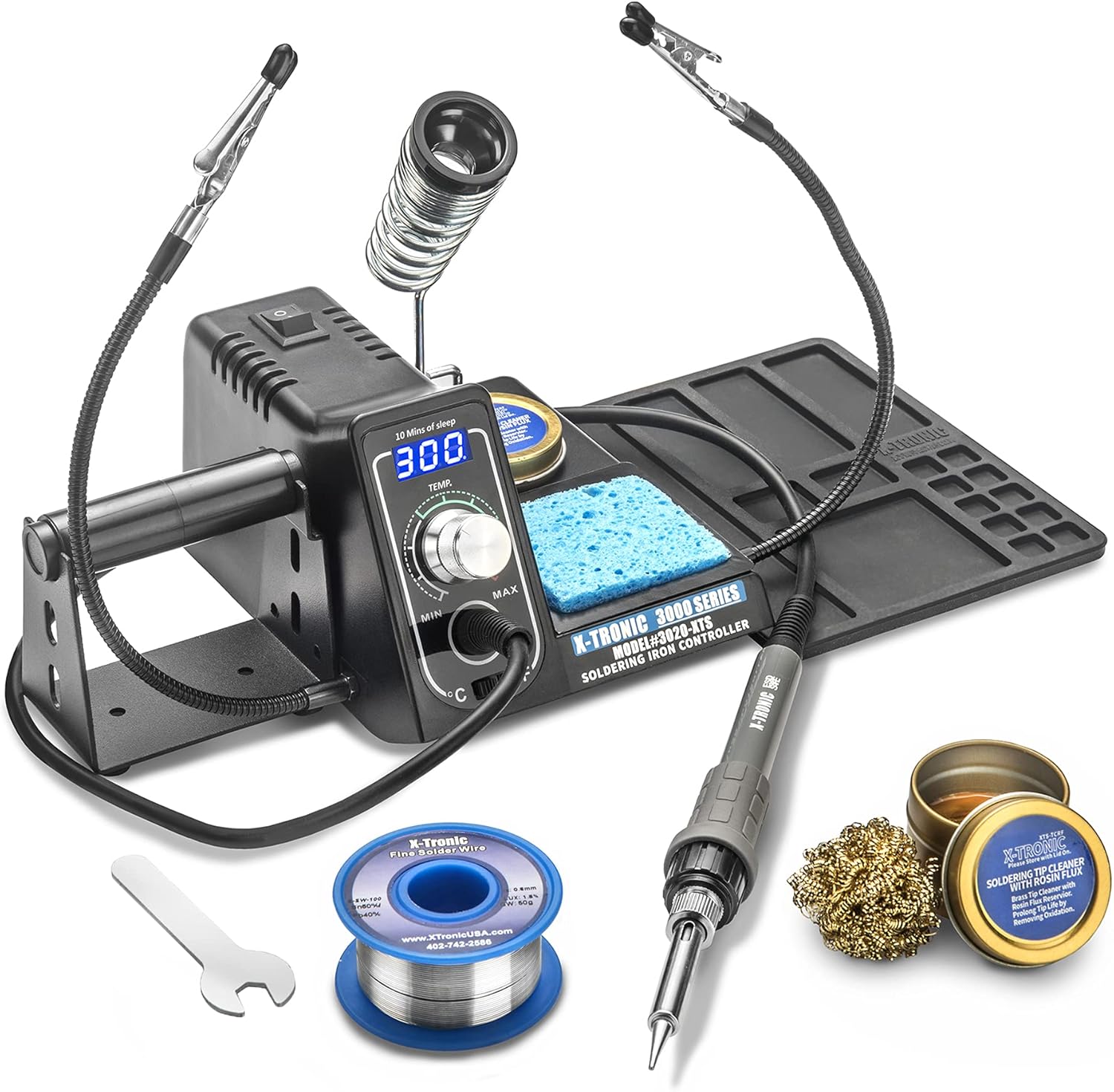
The X-Tronic 3020-XTS undercuts Hakko and Weller significantly while still delivering genuine PID (proportional-integral-derivative) closed-loop temperature control, which is the same underlying technology that makes the more expensive stations hold temperature accurately under load. The station includes a soldering iron and a separate hot air rework gun in one base unit, which is a meaningful bonus for anyone working with surface-mount components that need localised reflow rather than a hand-held iron.
Build quality is a step below Hakko and Weller, and the tip ecosystem is smaller and less standardised, but for the price the feature set is genuinely impressive. The station includes a fume extraction fan built into the iron holder, a magnifying glass on an articulating arm, and a solder spool holder, essentially bundling several accessories that would otherwise be separate purchases. For a hobbyist setting up a first real bench rather than a single iron, the included extras add real value beyond the base unit price.
Specifications:
- Control type: Digital PID, closed-loop temperature control
- Temperature range: 194-896°F (90-480°C)
- Includes: Soldering iron, hot air rework gun, fume extractor, magnifying glass, solder spool holder
- Wattage: 70W soldering iron, additional wattage for hot air gun
- Tip system: 900M series compatible
Why it stands out:
- Genuine PID temperature control at a price well below Hakko or Weller equivalents
- Hot air rework gun included in the same base unit, useful for SMD component removal and reflow
- Built-in fume extraction reduces solder smoke exposure during extended sessions
- Bundled magnifying glass and solder holder add practical bench setup value
- Good entry point into dual iron/hot-air workflows without buying two separate tools
Things to keep in mind:
- Tip ecosystem is smaller and less standardised than Hakko T18 or Weller ETA tips
- Build quality and long-term durability trail the premium brands, as expected at this price
- Hot air gun adds capability but also adds learning curve for anyone new to rework
👉 Buy X-Tronic 3020-XTS Soldering Station on Amazon
Verdict: The best value pick if you want a full-featured bench setup rather than just an iron. The hot air rework capability and bundled accessories make this a smart choice for a first real workbench, even if the core iron does not quite match Hakko or Weller in build quality.
4. Best Value Digital Control: YIHUA 939D+
YIHUA 939D+ Digital Soldering Station
Best for: Buyers who want accurate digital temperature control without paying for a full-featured multi-tool station.

The YIHUA 939D+ occupies the space between a basic fixed-wattage iron and a premium Hakko or Weller station: genuine digital temperature control, a stable base unit, and a straightforward single-purpose design, all at a price closer to a beginner kit than a professional station. It skips the extras that the X-Tronic bundles in, focusing instead on doing the core job of accurate, stable soldering temperature well.
The digital display shows the set temperature and actual tip temperature simultaneously, which is a genuinely useful diagnostic feature: you can watch the iron recover after a joint and get a feel for how your technique affects heat transfer. The ceramic heating element inside the iron heats up in around 60 seconds from cold, which is slower than the premium stations but perfectly reasonable for hobbyist use. YIHUA has built a solid reputation among budget-conscious hobbyists over the past several years, and the 939D+ is generally considered their best current model.
Specifications:
- Control type: Digital display, closed-loop temperature control
- Temperature range: 176-896°F (80-480°C)
- Wattage: 60W (some listings 75W depending on region)
- Tip system: 900M series compatible
- Heat-up time: Approximately 60 seconds from cold
Why it stands out:
- Genuine closed-loop digital control at a price point close to fixed-wattage irons
- Simultaneous set and actual temperature display helps you understand tip recovery behaviour
- Compatible with widely available and inexpensive 900M-series tips
- Simple, single-purpose design without unnecessary bundled accessories driving up cost
- Strong reputation among budget-focused electronics hobbyists as a reliable daily driver
Things to keep in mind:
- Heat-up and recovery times are noticeably slower than Hakko or Weller stations
- Build quality is adequate but not built for heavy daily professional use
- No ESD certification stated, so verify grounding if working with highly static-sensitive components
👉 Buy YIHUA 939D+ Soldering Station on Amazon
Verdict: The best entry point into real digital temperature control if the premium stations are outside your budget. It will not match Hakko or Weller on recovery speed, but for most hobbyist projects the difference will not be the bottleneck in your work.
5. Best Budget Portable Iron: PINECIL
PINECIL Smart Mini Portable Soldering Iron
Best for: Makers who want a genuinely capable soldering iron that fits in a bag and runs from any USB-C PD power source.

The PINECIL disrupted the portable soldering iron market when it launched, and it remains the reference point competitors are measured against. Built by Pine64 around open-source IronOS firmware, it accepts power through either USB-C (PD and QC 3.0 supported) or a DC5525 barrel jack, meaning it runs from a laptop charger, a power bank, or a bench supply interchangeably. The stainless steel core housed in a polycarbonate shell keeps it light and pocket-friendly without feeling fragile.
Heat-up to operating temperature takes around 12 seconds, which is remarkably fast for a device this size, and an on-demand rapid boost feature pushes past that when you need extra heat quickly for a stubborn joint. Auto standby engages when the iron is set down, both saving power and reducing the risk of an accidental burn. The open-source firmware means the iron receives ongoing community updates and supports genuinely useful features like custom temperature profiles, which closed-firmware competitors typically lock behind proprietary apps or do not offer at all.
Specifications:
- Power input: USB-C (PD, QC 3.0) or DC5525 barrel jack (power supply not included)
- Wattage: 65W
- Heat-up time: ~12 seconds to operating temperature
- Firmware: Open-source IronOS
- Construction: SAE 304 stainless steel core, polycarbonate shell
- Includes: Iron, Type B2 tip
Why it stands out:
- Dual power input (USB-C or barrel jack) makes it compatible with almost any power source you already own
- Open-source IronOS firmware receives ongoing community development and feature updates
- 12-second heat-up time is exceptionally fast for a portable iron
- Auto standby extends tip life and reduces accidental burn risk when not actively soldering
- Genuinely usable as a primary iron for light-to-medium hobby work, not just a travel backup
Things to keep in mind:
- Power supply (USB-C PD charger or barrel jack adapter) not included, budget for this separately if you do not already own a compatible charger
- Less thermal mass than a full bench station, so it can struggle briefly on very large ground pours
- Tip changes require the iron to cool down first, unlike some hot-swap systems
👉 Buy PINECIL Soldering Iron on Amazon
Verdict: The best portable iron for the money by a wide margin. If you want an iron that travels with you, works from gear you likely already own, and still performs well enough for daily hobby use, this is the one to buy.
6. Best Value Portable Smart Iron: UY CHAN TS101-Style Smart Iron
UY CHAN Programmable Pocket-Size Soldering Iron (TS100/TS101 Compatible)
Best for: Buyers who want the TS100/TS101-style smart iron experience, with USB-C PD power and programmable firmware, at a lower price point.

This compact iron follows the design lineage that started with the original TS100 and continued through the TS101: a pen-style form factor, USB-C PD power input up to 65W, and programmable smart firmware that displays real-time temperature on a small OLED screen built into the handle. It ships with a B2 solder tip and a USB-C cable, and runs from any compatible USB-C PD power adapter, matching the flexibility of the PINECIL above.
The pocket-size design and acceleration-based wake feature (the iron senses movement and wakes from standby automatically) make it genuinely pleasant to use for quick repairs and light project work. Community firmware support for this style of iron is broad, since the TS100/TS101 hardware format has become something of an open design standard across several manufacturers. For anyone comparing portable smart irons on a budget, this is a capable option that delivers most of what the more expensive named-brand versions offer.
Specifications:
- Power input: USB-C PD, 45-65W depending on power source
- Display: OLED screen on handle showing real-time temperature
- Form factor: Pocket-size pen style
- Includes: Iron, B2 solder tip, USB-C cable
- Wake feature: Acceleration-based auto wake from standby
Why it stands out:
- USB-C PD power input matches the flexibility of pricier portable iron options
- OLED display on the handle shows live temperature without needing a separate screen
- Acceleration-based wake is a genuinely convenient feature for quick, repeated use
- Compatible with the broader TS100/TS101-style firmware and tip ecosystem
- Strong customer ratings reflect solid real-world performance for the price
Things to keep in mind:
- Requires a compatible USB-C PD power adapter, not included in the box
- Tip selection is more limited than dedicated bench station tip ecosystems
- Best suited to light and medium soldering work rather than heavy daily production use
👉 Buy UY CHAN Portable Soldering Iron on Amazon
Verdict: A capable and well-reviewed pocket iron for anyone who wants the smart, programmable portable soldering experience without paying premium pricing. Pair it with a good USB-C PD charger and it handles most hobby soldering tasks comfortably.
7. Best Professional Splurge: JBC CD-2BQF
JBC CD-2BQF Compact Soldering Station
Best for: Serious hobbyists, small business owners, and anyone running a home lab who wants professional-grade performance and is willing to pay for it.

JBC is the brand that professional repair technicians and PCB assembly houses reach for when Hakko and Weller are not quite fast enough. The CD-2BQF is JBC’s compact station, built around cartridge-tip technology where the heating element sits directly inside the tip itself rather than in a separate handle. This design delivers heat-up times and thermal recovery that genuinely outperform standard iron-and-heater designs, often reaching working temperature in a couple of seconds and recovering from a heavy joint almost instantly.
This station costs significantly more than everything else in this roundup, and that premium buys you a level of performance most hobbyists will never fully exploit. It earns its place here as an aspirational pick: for anyone running a small electronics repair business, doing serious PCB rework professionally, or simply wanting the best tool available regardless of cost, the JBC represents the ceiling of what a compact soldering station can do. The cartridge tip system also means near-instant tip changes, since you are swapping the entire heating cartridge rather than waiting for a separate element to cool.
Specifications:
- Control type: Cartridge-tip integrated heating, closed-loop control
- Temperature range: 90-450°C (194-842°F)
- Heat-up time: Approximately 2-3 seconds to working temperature
- Tip system: JBC cartridge tips (heater integrated into tip)
- Build: Professional-grade compact station housing
Why it stands out:
- Cartridge-tip design delivers heat-up and recovery speeds that outperform traditional iron designs
- Professional-grade reliability trusted by repair technicians and PCB assembly professionals
- Near-instant tip swaps since the heating element travels with the tip
- Compact footprint despite professional-tier performance
- The clear choice if budget is not the limiting factor and you want the best available
Things to keep in mind:
- Significantly more expensive than every other station in this roundup
- Cartridge tips cost more individually than traditional Hakko or Weller tips
- Overkill for casual hobbyists who solder occasionally rather than daily
👉 Buy JBC CD-2BQF Soldering Station on Amazon
Verdict: Not a station most hobbyists need to buy, but the one to consider if you want genuinely professional performance and the budget allows for it. If you solder daily or run a small repair business, the speed difference pays for itself in time saved.
Which Soldering Station Should You Buy?
For most electronics hobbyists building on Arduino, ESP32, or Raspberry Pi projects, the Hakko FX888D is the best soldering station to buy first. The tip ecosystem, proven reliability, and fast recovery cover the vast majority of hobbyist soldering needs without over-spending. If ergonomics and build quality matter more to you than saving a small amount on price, the Weller WE1010NA is an equally strong alternative and genuinely comes down to personal preference between the two ecosystems.
If your budget is tighter but you still want real digital temperature control, the YIHUA 939D+ delivers the core benefit of closed-loop control without the premium price tag. The X-Tronic 3020-XTS is the better pick if you want a fuller bench setup with hot air rework capability bundled in from day one.
For portability, the PINECIL is the best all-around choice: fast heat-up, flexible power input, and genuinely capable as a primary iron for light-to-medium work. The UY CHAN portable iron is a strong budget-friendly alternative in the same TS100/TS101-style category if you want similar features at a lower price point.
The JBC CD-2BQF is for a smaller audience: hobbyists with the budget for the best available tool, or anyone doing serious professional-adjacent work where the speed difference genuinely matters.
What Actually Matters When Choosing a Soldering Station
Closed-Loop Temperature Control Is the Real Upgrade
The single biggest difference between a $25 fixed-wattage iron and any station in this roundup is closed-loop temperature control. A fixed-wattage iron has no way to sense its own tip temperature, so it simply runs at whatever heat the wattage produces, overheating small joints and stalling on large ones. Every station here uses a sensor in the tip or heating element to hold a set temperature and adjust power output in real time. This is what actually improves your soldering results, more than any other single spec.
Recovery Speed Matters More Than Headline Wattage
Two stations can share the same wattage rating and perform very differently in practice. What matters is how quickly the tip recovers to set temperature after contacting a joint and drawing heat away. Hakko and Weller lead this roundup specifically because their heating elements recover fast, letting you work through a board without waiting between joints. This is the spec worth prioritising over raw wattage numbers when comparing stations.
Tip Ecosystem Affects Long-Term Cost
Buying into Hakko’s T18 system or Weller’s ETA system means cheap, widely available replacement and specialty tips for years. Budget stations using less standardised tip systems can end up costing more over time if tips are harder to source or more expensive per unit. Factor this into the purchase decision, especially if you plan to solder regularly rather than occasionally.
Final Recommendation
The Hakko FX888D is the station most hobbyists should buy first. It balances price, reliability, and tip availability better than anything else in this roundup, and it will genuinely last for years of regular use. If portability matters more than bench performance, pair it eventually with a PINECIL for travel and field repairs, since the two serve different purposes rather than competing directly.
Before your first session with a new station, ArduinoYard’s beginner’s guide to PCB soldering covers the technique fundamentals, tip tinning, and joint inspection habits that matter more than the station specs alone.
Setting up a complete electronics bench? Our guides on the Best Multimeters for Electronics Beginners, Best Helping Hands Soldering Tool, and Best Soldering Kits for Beginners round out the tools worth having alongside a good station.