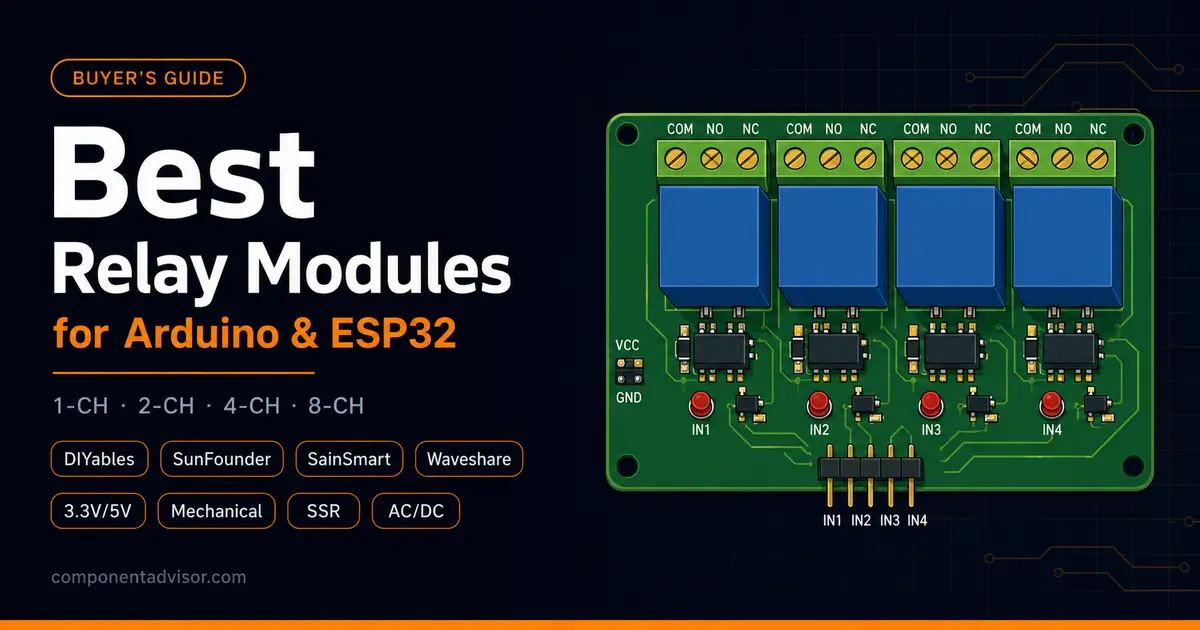
The best relay module for Arduino and ESP32 projects must match both your load and your microcontroller’s logic voltage. That second part causes most of the confusion. A board can contain 5V relay coils while still accepting a 3.3V signal from an ESP32, but not every cheap module does this reliably.
Channel count matters too. A single relay is ideal for learning or controlling one pump, while a four or eight-channel board makes more sense for irrigation, lighting, and home automation. You also need to decide between mechanical relays, which can switch AC or DC, and solid-state relays, which are silent but much more load-specific.
This guide compares six useful options, from a simple single-channel module to a complete ESP32-S3 relay controller. It also explains the voltage, trigger, contact, and isolation specifications that determine whether a board will work safely in your project.
Still choosing the controller and power setup? See our guides to the best ESP32 development boards and the best bench power supplies for Arduino and ESP32 projects.
Quick Comparison Table
| Product | Type / Channels | Trigger and Control | Load Type | Best For |
|---|---|---|---|---|
| DIYables 1-Channel Relay, 3-Pack | Mechanical, 1 channel per board | Selectable high or low, 3.3V/5V logic | AC or DC | Most hobby projects and first relay builds |
| SunFounder 2-Channel Relay | Mechanical, 2 channels | Active low, 5V module | AC or DC | Two independent pumps, lights, or valves |
| DIYables 4-Channel Relay | Mechanical, 4 channels | Selectable high or low, 3.3V/5V logic | AC or DC | ESP32 automation with several outputs |
| SainSmart 8-Channel Relay | Mechanical, 8 channels | 3.3V/5V compatible inputs | AC or DC | Larger control panels and automation systems |
| SainSmart 8-Channel SSR | Solid state, 8 channels | Active high, 3.3V/5V compatible | AC only | Silent and frequent AC switching |
| Waveshare ESP32-S3 Relay 6CH | Integrated ESP32-S3, 6 mechanical relays | Onboard MCU, Wi-Fi, BLE, and RS485 | AC or DC | Complete networked relay controller |
1. Best Overall Relay Module for Arduino and ESP32
DIYables 1-Channel 5V Relay Module, 3-Pack
Best for: First relay projects, single pumps, lamps, fans, solenoids, and general prototyping.

The DIYables single-channel board is the easiest option here to recommend for mixed Arduino and ESP32 use. Its relay coil runs from 5V, while the control input is specified for 3.3V to 5V logic. That removes the uncertainty found with many generic 5V modules when an ESP32 is providing the control signal.
The high or low-level trigger is selected with a jumper, and you get three separate boards in the pack. This is more flexible than buying one multi-channel board if your loads are located in different parts of a project.
Specifications:
- Relay type: Mechanical SPDT
- Channels: One per board, three boards included
- Relay supply: 5V DC
- Control input: 3.3V to 5V logic
- Trigger mode: Jumper-selectable active high or active low
- Contacts: COM, NO, and NC
- Manufacturer contact rating: Up to 10A at 250VAC or 30VDC
- Isolation: Optocoupler on the control input
Why it stands out:
- Explicit compatibility with both Arduino and ESP32 logic
- Trigger polarity can be changed without modifying code
- Separate screw terminals on the control and load sides
- Three individual modules work well for distributed projects
- Power and relay-status LEDs simplify testing
Things to keep in mind:
- The module requires 5V power even when controlled by a 3.3V ESP32
- The printed 10A contact figure is a maximum rating, not a recommended continuous design target
- Mechanical contacts click and eventually wear with frequent switching
- An enclosure and properly rated protection are still required for mains wiring
👉 Buy DIYables 1-Channel Relay Module on Amazon
Verdict: This is the best starting point for most readers. It is easy to wire, well suited to 3.3V and 5V controllers, and the three-pack gives you more flexibility than a fixed multi-channel board.
2. Best Two-Channel Relay Module
SunFounder 2-Channel DC 5V Relay Module
Best for: Controlling two related loads, such as a pump and valve, two lights, or forward and reverse contactors.

SunFounder’s two-channel module fills the useful gap between a single relay and the larger automation boards. Each channel has its own indicator and COM, NO, and NC terminals, so the two loads remain independently controlled.
The inputs are active low and optocoupled. SunFounder lists compatibility with Arduino and Raspberry Pi, which covers common 5V and 3.3V control systems. The board itself still needs a stable 5V supply, and ESP32 users should confirm the relay stays off at a 3.3V HIGH level before connecting the real load.
Specifications:
- Relay type: Mechanical SPDT
- Channels: Two
- Module supply: 5V DC
- Trigger mode: Active low
- Input drive: Approximately 15 to 20mA per channel
- Contacts: COM, NO, and NC for each channel
- Manufacturer contact rating: Up to 10A at 250VAC or 30VDC
- Isolation: Optocoupled inputs
- Indicators: Per-channel relay status LEDs
Why it stands out:
- Useful channel count without the size of a four or eight-relay board
- Established brand with clear specifications
- Independent SPDT outputs for two loads
- Low-level triggering works naturally with many control systems
- Mounting holes make permanent installation easier
Things to keep in mind:
- Trigger polarity is fixed, so LOW normally means ON
- It does not offer the same selectable trigger flexibility as the DIYables boards
- Give the board its own regulated 5V supply if the rest of the circuit is close to its power limit
- Set the GPIO to the inactive state early in
setup()to prevent a brief startup click
👉 Buy SunFounder 2-Channel Relay Module on Amazon
Verdict: Choose the SunFounder when two outputs are exactly what your project needs. It is compact, well documented, and more convenient than wiring two unrelated single-channel boards side by side.
3. Best Four-Channel Relay Module for ESP32
DIYables 4-Channel 5V Relay Module
Best for: ESP32 home automation, irrigation controllers, lighting systems, and projects with three or four switched loads.

Four channels are the sweet spot for many automation projects. This DIYables board provides four independent mechanical relays while explicitly supporting 3.3V and 5V control logic. That makes it a better fit for ESP32 than boards that only mention 5V TTL inputs.
Selectable high or low-level triggering also helps with startup behavior and existing code. All four channels expose both normally open and normally closed contacts, so one board can handle several different control arrangements.
Specifications:
- Relay type: Mechanical SPDT
- Channels: Four
- Relay coil supply: 5V DC
- Control input: 3.3V to 5V logic
- Trigger mode: Jumper-selectable active high or active low
- Contacts: COM, NO, and NC per channel
- Manufacturer contact rating: Up to 10A at 250VAC or 30VDC
- Isolation: Optocoupler inputs
- Connections: Screw terminals for control power and switched loads
Why it stands out:
- Confirmed 3.3V control compatibility for ESP32 and Raspberry Pi
- Four channels cover many practical automation projects
- Selectable trigger polarity makes firmware integration easier
- Input-side screw terminals are more secure than loose Dupont connections
- Individual status LEDs make multi-channel troubleshooting faster
Things to keep in mind:
- Four energized coils draw far more current than a single relay
- Use a separate regulated 5V supply rather than the ESP32’s 3.3V pin
- Optocouplers only provide useful input isolation when the board is wired for it correctly
- Motors, pumps, and solenoids need suppression appropriate to the load and supply type
👉 Buy DIYables 4-Channel Relay Module on Amazon
Verdict: This is the most balanced choice for an ESP32 automation build with several outputs. You get enough channels for a useful control system without jumping to the size, current demand, and wiring of an eight-relay board.
4. Best Eight-Channel Mechanical Relay Module
SainSmart 8-Channel 5V Relay Module
Best for: Control cabinets, holiday lighting, test fixtures, greenhouse systems, and larger home automation projects.

The SainSmart board puts eight mechanical SPDT relays on one PCB and supports both 3.3V and 5V control logic. It is a practical way to centralize several loads instead of filling a panel with individual modules.
Eight channels also change the power requirements. A bank of energized 5V coils can draw several hundred milliamps, so this board deserves its own regulated supply. The GPIO pins only provide control signals and should never be expected to power the relay coils.
Specifications:
- Relay type: Mechanical SPDT
- Channels: Eight
- Module supply: 5V DC
- Logic compatibility: 3.3V and 5V controllers
- Contacts: COM, NO, and NC per channel
- Manufacturer contact rating: Up to 10A at 250VAC or 30VDC
- Isolation: Optocoupled control inputs plus isolated relay contacts
- Indicators: LED status indication for each channel
Why it stands out:
- Eight independent outputs on one organized board
- Compatible with Arduino, ESP32, Raspberry Pi, and similar controllers
- SPDT contacts support both NO and NC wiring
- Easier to mount and cable than eight separate relay modules
- Good fit for central automation and test systems
Things to keep in mind:
- Use a suitably rated external 5V supply, especially when many channels may turn on together
- The board needs eight GPIO signals unless you add an I/O expander
- A failure or power issue affects the entire relay bank
- Large mains installations require a proper enclosure, fusing, strain relief, spacing, and qualified wiring
👉 Buy SainSmart 8-Channel Relay Module on Amazon
Verdict: Buy this when you actually need five to eight mechanical outputs in one location. For only two or three loads, the smaller DIYables boards are easier to power, wire, and fit into an enclosure.
5. Best Solid-State Relay Module
SainSmart 8-Channel 5V Solid-State Relay Module
Best for: Silent, frequent on and off control of compatible AC loads.
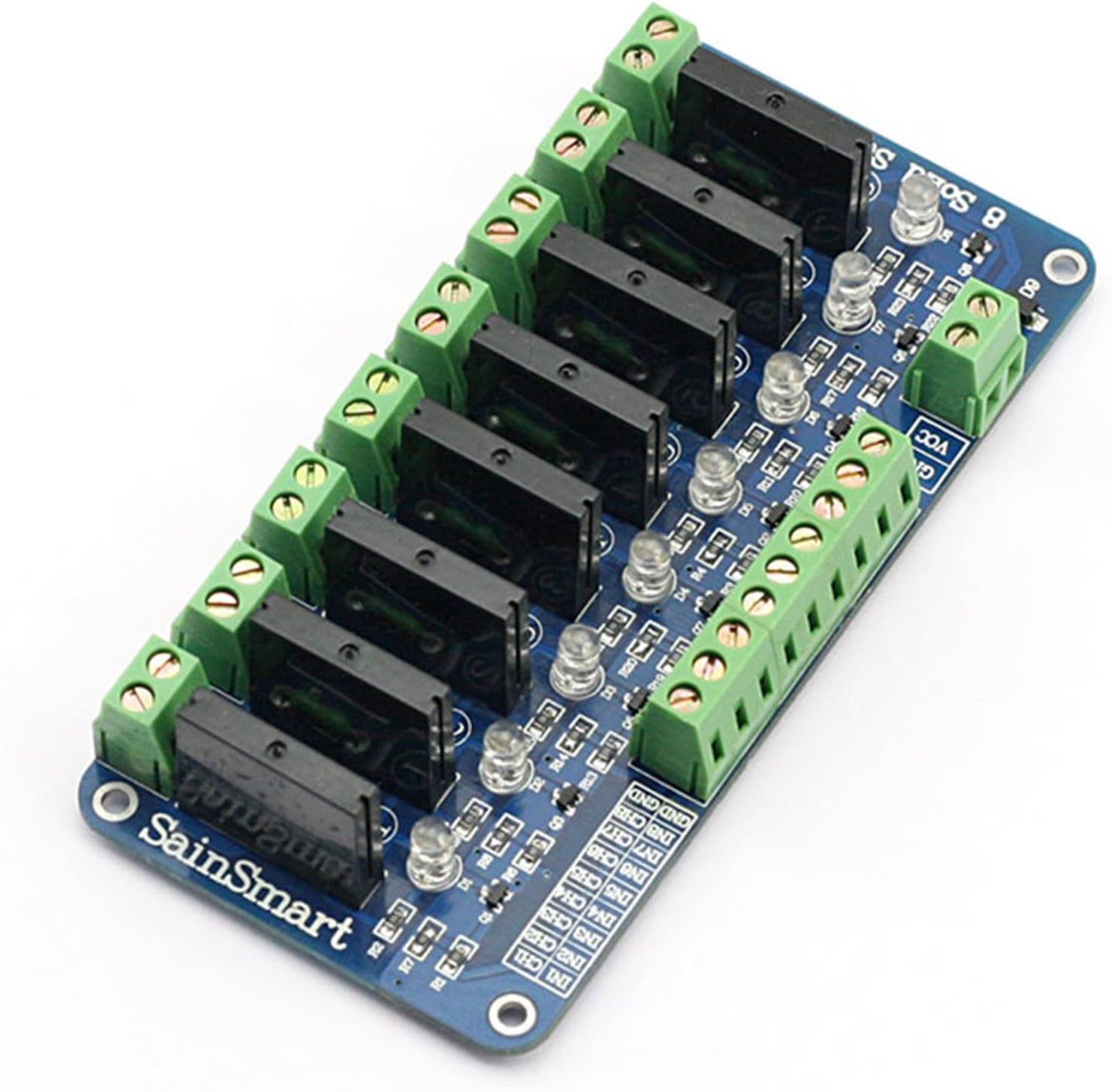
This SainSmart board replaces moving contacts with G3MB-202P-type phototriac solid-state relays. Switching is silent, there is no mechanical contact bounce, and there are no contacts to wear out. It is a strong option for frequent switching of modest AC loads.
The tradeoff is much narrower load compatibility. These are AC triac outputs, so they cannot switch DC. They also leak a small current while off and dissipate heat while on, which makes their 2A nameplate rating a ceiling rather than a comfortable target for an enclosed eight-channel installation.
Specifications:
- Relay type: Zero-cross phototriac solid-state relay
- Channels: Eight
- Board supply: 5V DC, approximately 160mA with all channels on
- Trigger mode: Active high
- Input HIGH threshold: 2.5V to 20V
- Output range: 75 to 264VAC, 50/60Hz
- Manufacturer output rating: 0.1 to 2A per channel
- Output contacts: Normally open only
Why it stands out:
- Silent operation with no mechanical clicking
- No moving contacts to wear during frequent switching
- 3.3V and 5V GPIO signals can activate the inputs
- Zero-cross switching reduces electrical noise for suitable AC loads
- LED indicator provided for every channel
Things to keep in mind:
- It cannot switch DC loads
- No normally closed output is available
- Off-state leakage can make some LED lamps glow faintly
- Current capability must be derated for heat, enclosure temperature, and simultaneous channel use
- It is not the right board for phase-angle dimming or large motor loads
👉 Buy SainSmart 8-Channel Solid-State Relay Module on Amazon
Verdict: This is the specialist pick, not the default recommendation. Buy it when you need silent, repeated switching and know your loads are compatible AC devices; choose a mechanical board for DC loads or mixed-use experimentation.
6. Best All-in-One ESP32 Relay Controller
Waveshare ESP32-S3 Relay 6CH
Best for: Networked control panels, DIN-rail installations, MQTT projects, and systems that need Wi-Fi or RS485 without a separate development board.

The Waveshare is different from every other product here because the controller is already built in. An ESP32-S3 directly controls six mechanical relays, with Wi-Fi, Bluetooth LE, isolated RS485, USB-C programming, and a wide-voltage terminal input on the same assembly.
It also includes power, digital, and optocoupler isolation stages plus surge-protection components and a rail-mount ABS case. For a permanent connected controller, that is a cleaner starting point than combining a loose ESP32 board, relay bank, converter, and enclosure yourself.
Specifications:
- Controller: ESP32-S3, dual-core up to 240MHz
- Relay type: Six mechanical SPDT channels
- Contacts: One NO and one NC output per channel
- Manufacturer contact rating: Up to 10A at 250VAC or 30VDC
- Power input: USB-C 5V or 7V to 36V DC through the terminal input
- Connectivity: 2.4GHz Wi-Fi, Bluetooth LE, USB, and isolated RS485
- Expansion: Raspberry Pi Pico HAT-compatible header
- Installation: Rail-mount ABS enclosure
- Programming: Arduino framework or MicroPython
Why it stands out:
- ESP32-S3 and six relays are integrated into one tested assembly
- Wi-Fi and RS485 support both home and industrial-style networks
- Wide DC input range simplifies control-panel power design
- Better isolation and protection features than typical bare relay boards
- Enclosure and DIN-rail format suit permanent installations
Things to keep in mind:
- This replaces the external ESP32 rather than connecting to one as a simple module
- It is unnecessary for a basic Arduino project or one switched load
- You still need to write or adapt the control firmware
- The case does not replace load fuses, circuit protection, or safe mains wiring practices
👉 Buy Waveshare ESP32-S3 Relay 6CH on Amazon
Verdict: The Waveshare is the strongest premium option for a complete networked controller. It costs more and demands more setup knowledge, but it eliminates much of the loose wiring and power integration involved in building the same system from separate boards.
Which Relay Module Should You Buy?
For a first project or any design with one switched load, buy the DIYables 1-Channel 3-Pack. Its 3.3V control compatibility and selectable trigger mode remove the two most common compatibility problems, while three separate boards give you room for future projects.
Choose the SunFounder 2-Channel if your project naturally has two loads in the same location. The DIYables 4-Channel is the better middle ground for irrigation, lighting, greenhouse, and smart-home builds controlled by an ESP32.
The SainSmart 8-Channel mechanical board makes sense when you need a central bank of AC and DC-capable outputs. Do not buy eight channels only because extra outputs seem attractive. The larger board needs more power, more GPIO pins, more enclosure space, and much more wiring.
Choose the SainSmart SSR board only for compatible AC loads when silent or frequent switching matters. It is not a universal replacement for a mechanical relay. If you need to switch DC, require an NC contact, or are unsure about the load, select one of the mechanical boards instead.
For a networked system that has not yet chosen its controller hardware, the Waveshare ESP32-S3 Relay 6CH is the cleanest integrated option. It is especially appealing for MQTT, web control, RS485 devices, and DIN-rail panels.
5V Relay Power vs 3.3V ESP32 Logic
A relay module has at least two relevant voltage requirements. The first is the coil or board supply, commonly 5V. The second is the voltage accepted by the IN control pin. These are not automatically the same.
An ESP32 outputs about 3.3V from its GPIO pins. A well-designed 5V relay board may recognize that as a valid HIGH or allow the ESP32 to activate an optocoupler by pulling the input LOW. Another board may need a signal closer to 5V and behave unpredictably, perhaps turning on but refusing to release.
Look for an explicit 3.3V logic specification rather than assuming every 5V board is ESP32-compatible. Power the relay coils from a regulated 5V source and connect only the control input to the ESP32 GPIO. Never feed 5V into an ESP32 pin.
Multi-channel modules need extra attention. A typical 5V mechanical relay coil may draw around 70mA while energized, so a full bank can consume several hundred milliamps. A separate 5V supply with adequate current margin prevents brownouts and random ESP32 resets. If the grounds are shared, connect them at a sensible common point and keep high-current load wiring away from signal wiring.
Mechanical Relay vs Solid-State Relay
Mechanical relays physically move a contact. They can switch AC or DC within their ratings, provide NO and NC contacts, and have very low resistance when closed. Their weaknesses are audible clicking, contact bounce, slower operation, and wear caused by arcing.
Solid-state relays use semiconductor devices and have no moving contact. They are silent, fast, and well suited to repeated switching. However, the output device determines the allowed load. The triac SSRs on the SainSmart board work with AC only. A DC solid-state relay needs a MOSFET or other DC-capable output stage.
SSRs also behave differently while off. A small leakage current can pass through a triac output, which may be enough to make a low-power LED lamp flicker or glow. While on, the semiconductor drops voltage and produces heat. This is why thermal derating matters even when the load appears to be below the advertised current.
Active High vs Active Low Triggering
An active-high module energizes its relay when the IN pin is HIGH. An active-low module energizes it when IN is pulled to ground. Neither method is inherently better, but your firmware must use the correct logic.
Startup behavior matters more than many buyers expect. Microcontroller pins briefly operate as inputs while the board boots, and some ESP32 pins have pull resistors or boot functions. A relay connected to the wrong pin can click or activate its load during reset. Select a safe GPIO, configure it as an output early, and immediately write the inactive state.
Jumper-selectable boards are convenient because you can choose the trigger mode that gives the safest power-up behavior. Still, test the complete controller through power-up, reset, Wi-Fi connection, firmware upload, and power loss before attaching a real appliance.
NO, NC, and COM Explained
COM is the moving common contact. With the relay coil off, COM connects to NC, the normally closed terminal. When the relay energizes, COM moves to NO, the normally open terminal.
Use COM and NO when the load should remain off if the controller loses power. This is the common choice for lamps, pumps, heaters, and other equipment that should not run unattended. Use COM and NC when the load should remain on until the relay deliberately interrupts it, but think through what happens during a controller or power failure.
The SainSmart solid-state board provides only a normally open switching path. It cannot reproduce the NC behavior of an SPDT mechanical relay.
What Optocoupler Isolation Actually Does
An optocoupler transfers a control signal using light, allowing two circuit sections to operate without a direct signal connection. It can improve noise immunity and, on boards designed with separate logic and relay supplies, help isolate the microcontroller side.
However, the optocoupler label does not make a complete project electrically isolated or safe for mains voltage. If the board shares grounds, or a VCC/JD-VCC jumper ties the supply sections together, some of the intended separation is lost. PCB spacing, terminal quality, enclosure design, wiring, fusing, and protective earth are separate safety concerns.
For low-voltage DC projects, a shared ground is usually the simplest arrangement. For mains switching, use purpose-built enclosures and protection, maintain physical separation between low and high-voltage wiring, and involve a qualified person if you are not trained to work with mains circuits.
Understanding Relay Load Ratings
The rating printed on a relay case is a maximum under stated test conditions. It does not mean every inexpensive module should continuously carry that current in a warm, enclosed project. PCB trace width, screw terminals, connector temperature, duty cycle, and the type of load all affect the safe practical limit.
Resistive heaters are relatively predictable. Motors, pumps, solenoids, transformers, and some LED power supplies can draw a large startup current or generate a voltage spike when switched off. Leave generous current margin and check the inrush rating of the actual load.
Use a flyback diode across a DC coil or solenoid, with correct polarity. AC inductive loads may need an RC snubber or MOV selected for the supply and load. Every load branch should have an appropriately rated fuse or circuit breaker. If the relay repeatedly runs hot, arcs heavily, or welds its contacts, the answer is not a larger software delay. Use a properly rated contactor or power switching device.
Final Recommendation
For most hobbyists, the DIYables 1-Channel 3-Pack is the best relay module for Arduino and ESP32 because it combines confirmed 3.3V logic support, selectable triggering, and a useful multi-pack format. For four-output automation, the DIYables 4-Channel Module is the better choice. The Waveshare ESP32-S3 Relay 6CH is the premium pick when you want a complete connected controller rather than a bare module.
Once your hardware arrives, ArduinoYard’s relay module with Arduino guide covers the basic wiring and code. ESP32 users should also check the ESP32 pinout and GPIO reference before choosing control pins. For connected automation ideas, see how to control ESP32 devices from a local web dashboard or build an ESP32 Telegram bot.
Related ComponentAdvisor guides: ESP32 vs Arduino, best Arduino board for beginners, best breadboard and jumper wire kit, and best multimeter for electronics beginners.
1 thought on “Best Relay Module for Arduino and ESP32”