
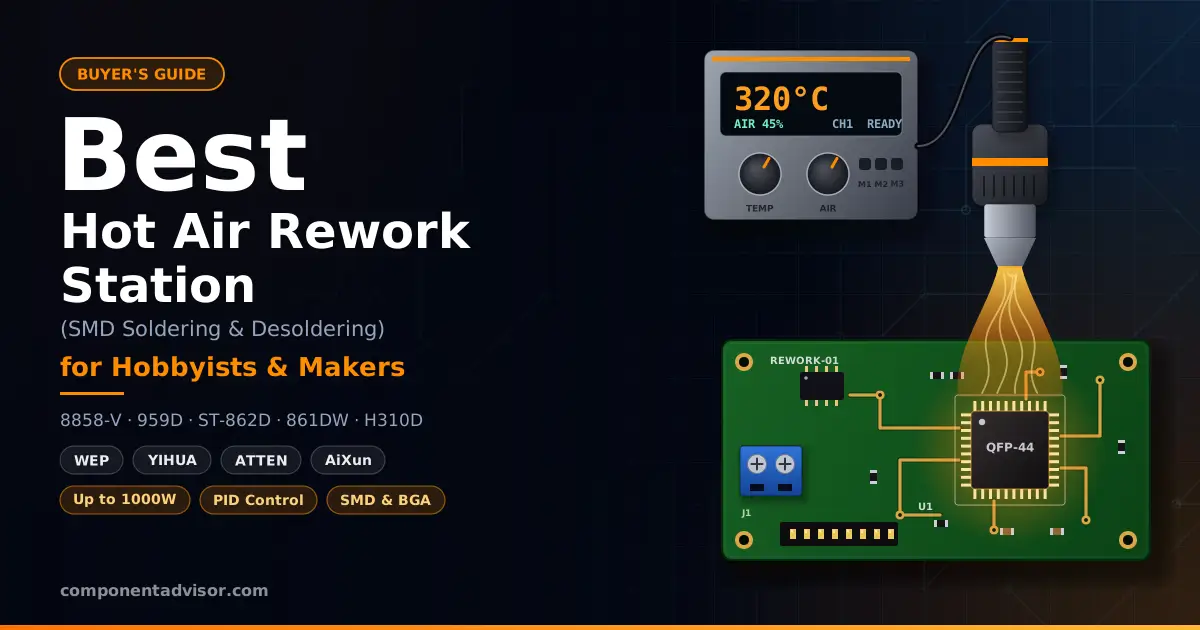
The best hot air rework station for hobbyists is the tool that finally makes surface-mount work feel manageable. A soldering iron is great for through-hole parts, but once you need to lift a QFP chip, replace a dead SMD regulator or reflow a tiny module, you need controlled heat spread over a whole footprint. That is exactly what a hot air station delivers: a heated, adjustable stream of air that melts every joint at once.
If you build with Arduino, ESP32 or Raspberry Pi boards, you will hit this sooner than you expect. Clone boards, breakout modules and sensors are full of small SMD parts, and repairing or modifying them is much easier with hot air than with an iron alone.
This guide compares five stations on Amazon, from a compact budget kit to a smart Wi-Fi-connected unit. We focused on hot-air-first stations and left out 2-in-1 iron combos and hot air pencils, which belong in other buyer’s guides. A hot air station is also a serious heat source, so we cover technique and safety near the end.
Building your bench? See our guides to the best soldering kits for beginners and the best helping hands soldering tool.
Quick Comparison Table
| Model | Temperature Range | Airflow Control | Standout Feature | Best For |
|---|---|---|---|---|
| WEP 8858-V | Adjustable (PID) | Adjustable | Compact body with integrated nozzle holder | Beginners on a budget |
| YIHUA 959D | 212 to 932°F (100 to 500°C) | Adjustable | Three memory presets | Everyday SMD work |
| ATTEN ST-862D | 100 to 480°C | 20 to 130 L/min (spec) | 1000W with a brushless fan | Heavier boards and larger parts |
| 861DW 7-Nozzle Station | Adjustable | Adjustable | 1000W, auto sleep, seven nozzles | Nozzle variety |
| AiXun H310D | 100 to 500°C | Gear 1 to 100% | Touch display, Wi-Fi and Bluetooth | Tech-forward buyers |
1. Best Budget Pick: WEP 8858-V
WEP 8858-V Hot Air Rework Station Kit
Best for: First-time buyers who want a compact, low-cost way into hot air work.

The WEP 8858-V is the smallest and simplest station in this guide. The listing describes a compact body with an integrated nozzle holder, three nozzles, two tweezers, adjustable temperature and airflow, a PID program for steadier heat, and a °C/°F toggle. For a hobbyist who mostly needs to swap the odd SMD part, it covers the basics without taking over the bench.
Compact size matters more than it sounds. Hot air stations are usually bulky, and a unit that tucks beside your iron is easier to live with. The included tweezers are a useful extra when you are lifting small parts off a board.
Specifications:
- Control: adjustable temperature and airflow, with a PID program
- Included: 3 nozzles and 2 tweezers (per the listing title)
- Display: °C/°F conversion
- Design: compact, with an integrated nozzle holder
Why it stands out:
- The smallest footprint of the five stations
- PID control helps hold temperature steady during a job
- Nozzles and tweezers come in the kit
- Simple controls suit beginners
- The lowest-commitment way to try hot air
Things to keep in mind:
- Some listing variants for this model say “Iron Kit,” so confirm whether a soldering iron is included before you order
- Entry-level units have less headroom for large boards or heavy ground planes
- The listing title does not state wattage, so check the product page
Verdict: A sensible starter for occasional SMD work. If you expect to rework often or tackle bigger boards, step up to one of the higher-power stations below.
2. Best Everyday Station: YIHUA 959D
YIHUA 959D Digital Hot Air Rework Station
Best for: Hobbyists who want a dependable all-rounder with saved presets.

The YIHUA 959D is a well-known name in the hobby hot air category. The listing calls out three memories so you can save settings for different jobs, a °F/°C display, a 212 to 932°F range (about 100 to 500°C), a brushed aluminum panel and safety features. Other versions of the listing cite 700W and PID temperature control, so check the exact variant you are buying.
The memory presets are the practical highlight. Many rework jobs are repetitive, such as the same temperature and airflow for one type of chip, and being able to recall a setting in one press saves fiddling with dials each time.
Specifications:
- Temperature range: 212 to 932°F (about 100 to 500°C), per the listing
- Memory: 3 presets
- Display: °F/°C
- Build: brushed aluminum panel, with safety features per the listing
- Power: listing variants cite 700W with PID control, so confirm yours
Why it stands out:
- Three presets speed up repeated jobs
- Wide temperature range covers leaded and lead-free solder
- Metal front panel feels sturdier than basic plastic units
- A familiar brand with a large user base
Things to keep in mind:
- Listings for this model vary between sellers, so match the exact title before ordering
- Seven hundred watts is plenty for hobby work but less than the 1000W stations here
- Check the nozzle count in the box on the listing
Verdict: The default recommendation for most hobbyists. It offers a good mix of control, build quality and convenience without the extra cost of the smart models.
3. Best High-Power Value: ATTEN ST-862D
ATTEN ST-862D 1000W Hot Air Gun Soldering Station
Best for: Buyers working on larger boards or parts that soak up a lot of heat.

The ATTEN ST-862D is the power pick. The listing title confirms 1000W, a digital display and lead-free capability. A retailer specification sheet for the 110V model adds a 100 to 480°C range, 20 to 130 L/min airflow, a brushless fan, a pluggable heater and an auto-sleep function. It also describes straight and spiral airflow options and three shortcut presets.
More power helps with boards that have large copper planes, where a weaker station struggles to bring the whole area up to temperature. It also recovers faster after you point the nozzle at a cooler spot. Being able to swap the heater element yourself is a real advantage over sealed units.
Specifications:
- Power: 1000W (per the listing title)
- Temperature range: 100 to 480°C (212 to 896°F), per a retailer spec sheet
- Airflow: 20 to 130 L/min, per the same sheet
- Blower: brushless fan, pluggable heater
- Extras: auto-sleep, standby cooling, three shortcut presets
Why it stands out:
- Plenty of power for larger boards and shielded parts
- Brushless fan and replaceable heater suit long-term use
- Auto-sleep and standby cooling add safety
- Lead-free rated, with a stand included per the retailer sheet
Things to keep in mind:
- The listing title does not state the nozzle count, and the same model appears under several seller names with different bundles
- Confirm you are getting a 110V version for US outlets
- It is bigger and heavier than the compact units
Verdict: The best performance for the money in this lineup if you want headroom. It is more station than a casual user needs, but it will not run out of power.
4. Best for Nozzle Variety: 861DW 7-Nozzle Station
861DW 1000W Hot Air Rework Station with 7 Nozzles
Best for: Hobbyists who want a lot of nozzle options in the box.

This listing is for an 861DW-style station, a design family originally associated with Quick. The title specifies 110V, 1000W, a digital display, automatic sleep and seven air nozzles, with adjustable temperature. The brand is not named in the title, so treat it as a generic 861DW-class station and check the seller and brand on the product page.
Nozzle variety is the draw here. Different package sizes need different nozzles, and having seven in the box means you can match the nozzle to a QFP, SOIC or larger module without buying extras.
Specifications:
- Power: 1000W, 110V (per the listing title)
- Display: digital, with automatic sleep
- Nozzles: 7 (per the listing title)
- Use: SMD and BGA rework, per the listing
Why it stands out:
- Seven nozzles cover many package sizes
- 1000W power handles larger boards
- Automatic sleep reduces the risk of leaving heat running
- The 861DW design is widely used and well documented
Things to keep in mind:
- The title names no brand, so quality can vary by seller
- Reviewers who measured an 861DW-class station report real airflow well below the large number printed on the box, so do not treat the headline figure as liters per minute
- Check that the nozzle sizes included suit your parts
👉 Buy 861DW 7-Nozzle Station on Amazon
Verdict: A good pick if you want lots of nozzles and plenty of power. Buy it knowing it is a generic listing, and read recent buyer reviews first.
5. Best Smart Station: AiXun H310D
AiXun H310D 1000W Smart Hot Air Rework Station
Best for: Buyers who want a modern, connected station with a touch display.

The AiXun H310D is the most modern station here. Manufacturer and reseller specifications list a 3.5-inch IPS display, Type-C, Wi-Fi and Bluetooth connectivity, a 100 to 500°C range, a 1000W heater, airflow in gears from 1 to 100%, and straight or spiral air. It also includes a built-in database of chip desoldering parameters that can update from the cloud.
That database is the clever part. Instead of guessing temperature and airflow for an unfamiliar chip, you can start from a stored profile. It will not replace experience, but it gives beginners a sensible starting point.
Specifications:
- Power: 1000W heater (per manufacturer specs)
- Temperature range: 100 to 500°C
- Airflow: gears 1 to 100%, straight or spiral nozzles
- Display: 3.5-inch IPS
- Connectivity: Type-C, Wi-Fi, Bluetooth
Why it stands out:
- Large, clear touch display
- Stored desoldering parameters give a starting point for many chips
- Strong heater with fine airflow control
- Firmware and settings can be updated
Things to keep in mind:
- The manufacturer’s specification lists 220V input, so confirm your listing is a 110V version for US use
- You are paying for smart features that many hobbyists will not use
- One owner comparison on a forum found real airflow lower than the headline specification, though performance was similar to a Quick station
Verdict: The right choice if you like modern tools and want the extra convenience. For most hobby use, the simpler stations here do the same job for less.
Which Hot Air Rework Station for Hobbyists Should You Buy?
For most people shopping for a hot air rework station for hobbyists, the YIHUA 959D is the safest answer. It has the right mix of control, build quality and saved presets, and it is a name with plenty of community knowledge behind it. If you want to spend as little as possible and mainly need to swap the occasional SMD part, the compact WEP 8858-V gets you started with the least commitment.
Choose the ATTEN ST-862D if you work on bigger boards or parts with a lot of copper, because more power and a brushless fan make those jobs easier. If you like having plenty of nozzles in the box, the 861DW-style station is worth a look, as long as you check the seller and recent reviews because the listing is generic.
The AiXun H310D is for people who want a connected, touch-controlled station and will use the stored parameters. It is a good tool, but it is the one most likely to be more than you need.
One honest point: if you only ever solder through-hole parts and the odd header, you do not need any of these. Hot air earns its place once you start working with SMD packages, modules or repairs. Whichever you choose, pick the 110V version and confirm what is in the box before you order.
Hot Air Rework Basics: Temperature, Airflow and Nozzles
A hot air station has two main controls: temperature and airflow. Temperature needs to exceed the solder’s melting point. Leaded solder melts at around 183°C, while common lead-free alloys melt closer to 217 to 221°C, so rework settings usually sit well above that, often in the range of 300 to 380°C depending on the board and part. Treat those as starting points and adjust.
Airflow is just as important. Too much airflow blows small components away before the solder has melted, while too little heats the part unevenly. Start low for small parts and increase only as needed. A larger nozzle spreads the heat over a bigger area for chips, and a small one concentrates it on a single part.
The nozzle should be sized for the package. A nozzle that is too small heats only the middle of the chip, and one that is too large heats neighbouring parts you want to leave alone. This is why a kit with several nozzles is useful, and why most stations come with at least three.
Technique and Safety: Preheat, Flux and Ventilation
Good hot air technique is mostly about patience. Apply flux around the part, keep the nozzle moving in small circles a few centimetres above the board, and wait for the solder to flow before you touch the part with tweezers. Preheating the board gently first reduces thermal shock and makes the work easier on larger boards.
Protect nearby parts. Plastic connectors, headers and electrolytic capacitors can melt or deform, so shield them with heat-resistant tape or keep the nozzle away. Be careful with airflow near tiny passives, which can shift or fly off.
Safety matters because the nozzle and the air stream are very hot. Use the stand whenever you put the handle down, let the station cool before switching it off if it has a cooling cycle, and keep the area free of flammable material. Work with ventilation, since flux and solder fumes are unpleasant to breathe, and wear eye protection. A basic temperature check with a thermocouple is also a good habit, since stations can drift from their displayed value.
Final Recommendation
For most builders the YIHUA 959D is the pick, thanks to its saved presets, solid build and wide temperature range. If you want the cheapest way in, the WEP 8858-V does the job, and if you work on larger boards, the ATTEN ST-862D gives you the most headroom. In every case, the best hot air rework station for hobbyists is one with the right voltage, a nozzle set you will use and a power level that matches your boards. To sharpen your skills first, read ArduinoYard’s beginner’s guide to PCB soldering, and see its MAX6675 thermocouple guide if you want to build a simple temperature checker for your station.
Keep building: Best Multimeter for Electronics Beginners, Best Bench Power Supply, Best Oscilloscopes for Beginners and Best Resistor and Capacitor Kit.