
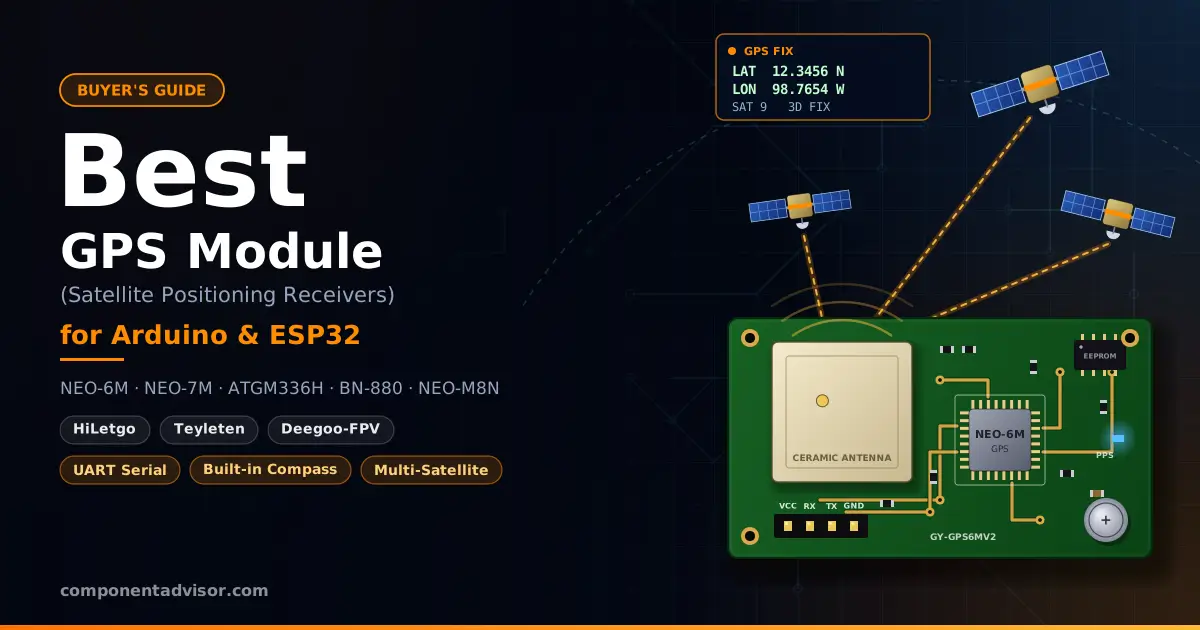
The best GPS module for Arduino is the one that gets a reliable fix where your project actually lives, not the one with the longest spec list. A GPS module is a small receiver that listens to satellites and sends your microcontroller the time, latitude, longitude, altitude and speed over a simple serial connection. It is the part that turns a project from “it works on my desk” into a tracker, a rover, a data logger or a clock that never drifts.
The market is dominated by one name: the u-blox NEO-6M, the module nearly every tutorial is written for. But it is an older chip, and newer modules add extra satellite systems, a built-in compass or a smaller footprint. Which one you want depends on whether you are logging a walk, steering a robot or just learning how NMEA data works.
This guide compares five GPS modules sold on Amazon, from the classic NEO-6M to a drone-style NEO-M8N puck with a built-in compass. We kept the lineup to modules that talk over a standard serial connection, so they work with an Uno, an ESP32 or a Raspberry Pi. We also flag where wiring and voltage need care.
Planning the rest of the build? See our guides to the best ESP32 development boards and the best LiPo battery and charger for Arduino.
Quick Comparison Table
| Model | Chipset | Satellite Systems | Compass | Best For |
|---|---|---|---|---|
| HiLetgo GY-NEO6MV2 NEO-6M | u-blox 6 | GPS only | No | Beginners and tutorials |
| HiLetgo NEO-7M | u-blox 7 | GPS or GLONASS | No | A simple upgrade from the NEO-6M |
| Teyleten ATGM336H | AT6558 | GPS and BeiDou | No | Compact builds |
| BN-880 | u-blox M8 | GPS and GLONASS (BeiDou configurable) | HMC5883L (varies) | Robots that need heading |
| Deegoo-FPV NEO-M8N | u-blox M8 | GPS and BeiDou | Yes, built in | Rovers and drones |
1. Best Budget Classic: HiLetgo GY-NEO6MV2 NEO-6M
HiLetgo GY-NEO6MV2 NEO-6M GPS Flight Controller Module
Best for: First-time GPS users who want the module every tutorial uses.

The GY-NEO6MV2 is the board most GPS tutorials for Arduino and ESP32 assume you own. The listing describes a u-blox NEO-6M with a ceramic antenna, built-in EEPROM for saving configuration, a 3 to 5V supply, a TTL serial interface and a default baud rate of 9600. It also includes a backup battery (an MS621FE) that helps the module restart faster after power is removed.
Because so many tutorials, libraries and forum answers target this exact board, it is the easiest module to get working. The trade-off is that the NEO-6M is GPS-only, so in poor sky conditions it has fewer satellites to work with than the newer multi-system modules.
Specifications:
- Chip: u-blox NEO-6M, GPS only
- Supply: 3 to 5V, per the listing
- Interface: TTL serial, default 9600 baud
- Extras: ceramic antenna, EEPROM configuration storage, backup battery (MS621FE)
- Pins: VCC, RX, TX and GND
Why it stands out:
- The most tutorial and library support of any GPS module
- Accepts 3.3V or 5V power, so it suits both ESP32 and Arduino boards
- Saved configuration survives a power cut
- Backup battery helps with quicker restarts
- Very low cost per module
Things to keep in mind:
- It is GPS-only, so fixes can be slower or less stable than on multi-system modules
- Many sellers list near-identical GY-NEO6MV2 boards in different pack sizes, so match the exact title
- The built-in ceramic antenna needs a clear view of the sky
👉 Buy HiLetgo GY-NEO6MV2 NEO-6M on Amazon
Verdict: The best place to start. If your goal is to learn NMEA data and get a location on screen, this module has the most help available.
2. Best NEO-6M Upgrade: HiLetgo NEO-7M
HiLetgo NEO-7M GPS Satellite Positioning Module
Best for: Builders who want a drop-in step up from the NEO-6M with the same simple wiring.

The NEO-7M is the natural upgrade path. The listing markets it as a replacement for the NEO-6M with a 3.3V or 5V supply, and it is built around a u-blox 7 chipset. A roundup of GPS modules describes it as able to use GPS or GLONASS, with no compass, which makes it a sensible next step if your NEO-6M struggles with fixes.
The big advantage is familiarity. It uses the same UART connection and the same libraries as the NEO-6M, so you can swap one for the other without rewriting your code.
Specifications:
- Chip: u-blox 7 family
- Supply: 3.3V or 5V, per the listing
- Interface: serial (UART)
- Satellite systems: GPS or GLONASS, per a roundup
- Compass: none
Why it stands out:
- Drop-in replacement for the NEO-6M
- Newer chipset with GLONASS as an option
- Same libraries and wiring as the module it replaces
- Wide supply range
- Priced close to the classic board
Things to keep in mind:
- It still has no compass, so it will not tell you which way a robot is facing
- It is a modest upgrade rather than a big leap
- The listing title mentions several platforms, so double-check the pin labels
👉 Buy HiLetgo NEO-7M on Amazon
Verdict: A low-risk upgrade if the NEO-6M’s fixes disappoint. If you want a bigger improvement, look at the M8-class modules further down.
3. Best Compact Pick: Teyleten ATGM336H
Teyleten Robot ATGM336H GPS+BDS Dual-Mode Module (2-Pack)
Best for: Small builds that want two satellite systems and a spare board.

The ATGM336H is the odd one out, because it does not use a u-blox chip. An Amazon comparison table lists its main chip as the AT6558, and the listing calls it a GPS+BDS dual-mode module, meaning it can use both GPS and China’s BeiDou system. The pack contains two boards, which is handy for prototyping or a spare.
The listing markets it as a replacement for the NEO-M8N and NEO-6M. That is a sales claim worth treating carefully, since it uses a different chipset. A roundup also notes that the antenna sits on a thin cable and the pins need soldering, so expect a little assembly.
Specifications:
- Chip: AT6558, per Amazon’s comparison table
- Satellite systems: GPS and BeiDou (dual-mode)
- Pack: 2 modules
- Interface: serial (UART)
- Assembly: pins need soldering, per a roundup
Why it stands out:
- Two satellite systems at a low price
- A pack of two gives you a spare
- Small enough for compact projects
- A useful alternative if you do not need u-blox firmware tools
Things to keep in mind:
- It is not a u-blox chip, so u-blox configuration tools and some libraries may not apply
- The antenna is on a thin cable and the pins need soldering
- The “replacement” wording in the title should be read as marketing, not a guarantee of identical behaviour
👉 Buy Teyleten ATGM336H on Amazon
Verdict: A sensible small-form-factor choice if you are comfortable soldering headers. It is less beginner-friendly than the NEO-6M because the tutorial support is thinner.
4. Best With Compass: BN-880
BN-880 GPS Module U8 With Flash and HMC5883L Compass
Best for: Robots and rovers that need to know which way they are facing as well as where they are.

The BN-880 combines a u-blox M8 GPS receiver with an HMC5883L compass on one small board. Listings and a roundup describe GPS plus GLONASS by default, with other systems configurable, flash memory to save settings, and a 28 x 28 x 10 mm footprint. The pins are SDA, SCL, TX, RX, VCC and GND, so the GPS runs over serial while the compass uses I2C.
Heading is the reason to buy it. A GPS alone can only work out direction when you are moving, but a magnetometer tells you which way the board is pointing even when it is standing still. That makes it useful for rovers, boats and anything that needs to steer toward a waypoint.
Specifications:
- GPS: u-blox M8 class receiver
- Satellite systems: GPS and GLONASS by default, per listings
- Compass: HMC5883L (I2C), per the title
- Memory: flash to save configuration
- Size: 28 x 28 x 10 mm
- Pins: SDA, SCL, TX, RX, VCC, GND
- Includes a 15 cm cable, per listings
Why it stands out:
- Newer M8-class receiver with multi-system tracking
- Compass and GPS together on one board
- Flash keeps your settings after a power cut
- Active antenna listed in the title
- Cable included for quick hookup
Things to keep in mind:
- A roundup notes the compass chip varies between units, so some boards may not use a genuine HMC5883L
- The compass needs calibration and works best away from motors and magnets
- It costs noticeably more than the NEO-6M and is overkill for a simple location display
Verdict: The best all-round pick for robots and rovers. Choose it when heading matters, and skip it if you only want coordinates.
5. Best for Rovers and Drones: Deegoo-FPV NEO-M8N Puck
Deegoo-FPV NEO-M8N GPS Compass Module for Pixhawk and APM
Best for: Mast-mounted or vehicle builds that want a stronger receiver in a ready-made housing.

This module is built for flight controllers rather than hobby breadboards. The listing describes a GPS and compass navigation module for Pixhawk, APM and PX4 systems. A roundup lists a u-blox M8 receiver with 72 channels, GPS and BeiDou, a TCXO for steadier timing, and a built-in compass in a puck-style housing with a cable.
The puck form is its strength. It is built to sit on a mast or the top of a vehicle with a clear view of the sky, and the M8 chip is a clear step above the NEO-6M for fix quality. The catch is that it is designed around drone connectors, so it takes more effort to use with a bare Arduino or ESP32.
Specifications:
- GPS: u-blox M8 class receiver, 72 channels, per a roundup
- Satellite systems: GPS and BeiDou
- Timing: TCXO
- Compass: built in
- Form: puck housing with cable
- Designed for: Pixhawk, APM and PX4 flight controllers
Why it stands out:
- Strong receiver with a stable TCXO
- Compass and GPS in a ready-made housing
- Suits roof or mast mounting for a clear sky view
- Familiar to rover and drone builders
Things to keep in mind:
- It is designed for flight controllers, so check the connector type and voltage before you plan the wiring
- The listing shows 3.8 out of 5 stars from 68 ratings, so read the recent reviews
- u-blox lists the NEO-M8N chip as not recommended for new designs, though hobby modules are still widely sold
👉 Buy Deegoo-FPV NEO-M8N on Amazon
Verdict: A good fit for rovers, boats and drones with a flight controller. For a plain Arduino or ESP32 project, the BN-880 is easier to live with.
Which GPS Module for Arduino Should You Buy?
For most people shopping for a GPS module for Arduino, the HiLetgo NEO-6M is the right starting point. It is cheap, runs from 3.3V or 5V, and has more tutorials and library examples than any other module. If you get it working and want better fixes without changing your code, the HiLetgo NEO-7M is the easy upgrade.
If your project moves and needs to know its heading, choose the BN-880. The compass is the whole point, and the M8 receiver gives you a more capable GPS than the older modules. The ATGM336H suits small builds where you are happy to solder and do not mind thinner tutorial support, and the two-pack is nice for prototyping.
The Deegoo-FPV NEO-M8N puck is for rovers, boats and drones, especially if you already use a flight controller. It is more module than a simple data logger needs.
One honest point: if you only want the time or a rough position indoors, no GPS module will help much, because they need a view of the sky. Plan to test outside or beside a window before you decide a module is faulty.
How a GPS Module Talks to Arduino and ESP32
Every module in this guide sends its data as NMEA sentences, plain text lines that carry time, position, speed and satellite information. Your microcontroller reads these over a serial (UART) connection, and a library such as TinyGPSPlus parses them into usable numbers. Tutorials for the NEO-6M commonly use that library, and it works the same way on the other modules here.
Wiring is simple. Connect the module’s TX to your board’s RX, its RX to your board’s TX, and share ground. On an Uno you usually use two spare pins with SoftwareSerial. On an ESP32 you can use a hardware serial port, and the common tutorial wiring uses UART2 on GPIO16 and GPIO17. The NEO-6M tutorial for ESP32 powers the module from the 3.3V pin, while Uno tutorials use 5V because the board accepts it. Check the supply range on your listing and the logic level of your board before you connect anything.
Baud rate matters too. Many modules default to 9600 baud, and your sketch has to match. If you see garbage in the serial monitor, a baud mismatch is the first thing to check.
Getting a Fix: Antenna Placement, Cold Starts and Accuracy
A GPS module is only as good as its view of the sky. Place the antenna outside or next to a window, facing up and away from large metal surfaces. Many tutorials note that testing indoors, away from a window, usually gives no fix at all. On NEO-6M boards, an onboard LED starts blinking once a position fix is found, which is a handy status check.
The first fix after a long time without power is called a cold start, and it can take noticeably longer than later restarts. Time to first fix depends on your sky view and the module, so be patient the first time and test outside. A backup battery or saved configuration helps later starts, which is why modules with EEPROM or flash and a backup cell are useful.
Do not expect centimetre accuracy. Hobby GPS modules typically give position errors of a few metres under open sky, and the figure gets worse near buildings, trees and metal. If you need much better than that, you are shopping for a different class of receiver.
Final Recommendation
For most builders the HiLetgo NEO-6M is the pick, thanks to its low cost and unmatched tutorial support, with the NEO-7M as the easy upgrade and the BN-880 the choice when heading matters. In every case, the best GPS module for Arduino is the one you can wire correctly and test under open sky, not the one with the biggest spec sheet. Once you have coordinates, log them with ArduinoYard’s ESP32 MicroSD data logger, show them with its SPI TFT display guide, and stretch battery life with its ESP32 sleep modes guide.
Keep building: Best Arduino Robot Car Kits, Best Arduino Sensor Kit, Best DC-DC Converter for Arduino and ESP32 and Best Multimeter for Electronics Beginners.