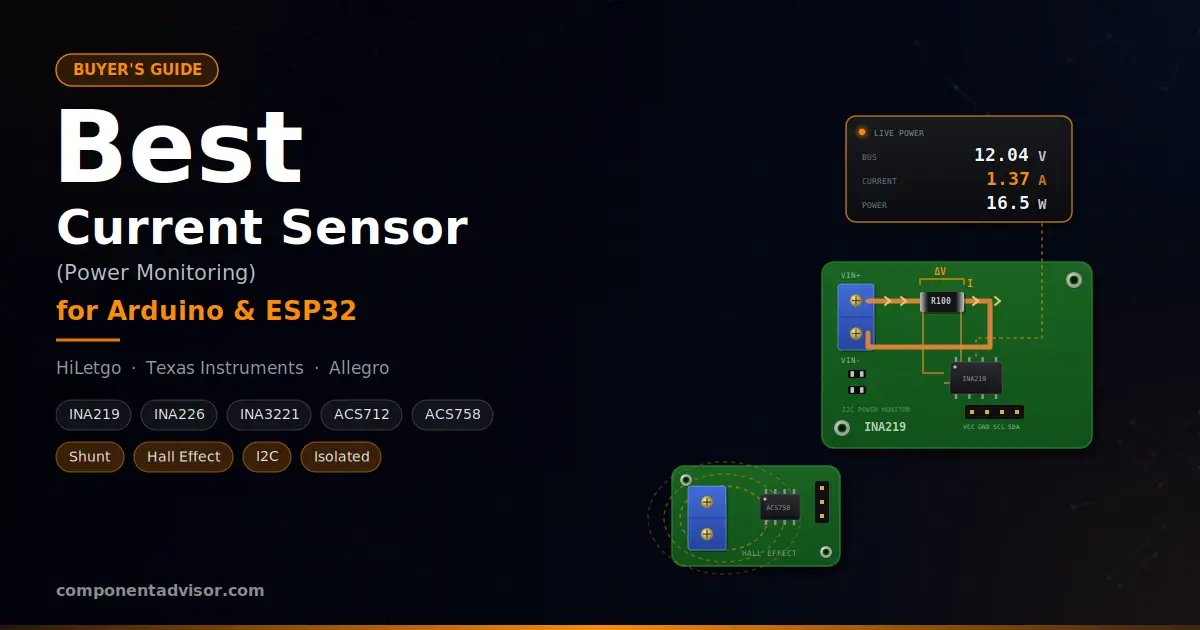
Picking the best current sensor for Arduino and ESP32 projects starts with a question that decides almost everything else: do you want a digital shunt monitor that reports voltage, current, and power over I2C, or an isolated Hall-effect sensor that can handle AC and much bigger loads at the cost of precision? The two families look similar on a product page, but they behave very differently once they’re wired into a real project.
This guide covers five modules across both families, from the INA219 that most tutorials start with to a 50A Hall-effect sensor for heavy loads. Along the way we’ll flag the quirks that spec sheets gloss over, like shunt values that differ between boards, a 5V sensor that can push a 3.3V ESP32 pin out of range, and why your first reading will probably be off until you calibrate it.
Measuring the draw of a battery-powered build? Our Best LiPo Battery and Charger for Arduino and ESP32 guide covers the pack side, and the Best DC-DC Converter for Arduino and ESP32 roundup covers the regulators whose efficiency you’ll want to measure.
Quick Comparison Table
| Sensor | Type | Voltage Range | Current Range | Interface | Best For |
|---|---|---|---|---|---|
| HiLetgo INA219 | Shunt monitor | 0 to 26V bus | About 3.2A full scale | I2C | Best budget/beginner power monitor |
| HiLetgo INA226 | Shunt monitor | 0 to 36V bus | Depends on the board’s shunt | I2C, alert pin | Best higher-precision monitor |
| HiLetgo INA3221 | 3-channel shunt monitor | 0 to 26V bus | About 1.6A per channel | I2C | Best multi-rail monitor |
| HiLetgo ACS712 30A | Hall effect | Isolated, AC or DC | ±30A | Analog (5V supply) | Best isolated/AC-capable sensor |
| HiLetgo ACS758 50A | Hall effect | Isolated, AC or DC | ±50A | Analog (3V to 5.5V supply) | Best for heavy loads |
1. Best Budget/Beginner Power Monitor: HiLetgo INA219
HiLetgo INA219 Current and Power Monitor Module (2-Pack)
Best for: Beginners who want voltage, current, and power readings from one cheap I2C module.

The INA219 is the module most Arduino current-sensing tutorials are written around, and it earns that spot by measuring three things at once: the voltage across the load, the current through it, and the power that results. It does this by reading the tiny voltage drop across a small shunt resistor on the board, so you wire it in series with the positive side of the load and read everything over two I2C wires.
It also plays well with others. The chip supports up to 16 I2C addresses, so several INA219 boards can share one bus, and it runs from 3V to 5.5V, which suits both a 5V Arduino and a 3.3V ESP32 without a level shifter. The catch is range: with the standard 0.1 ohm shunt it tops out around 3.2A, and the bus voltage limit is 26V, so it suits small projects, sensors, and battery-powered builds rather than motors or heaters.
Specifications:
- Type: high-side shunt monitor (voltage, current, power)
- Bus voltage: 0 to 26V
- Current: about 3.2A full scale with the standard 0.1 ohm shunt
- Interface: I2C, up to 16 selectable addresses
- Supply: 3V to 5.5V
- Direction: bidirectional current
Why it stands out:
- Reports voltage, current, and power from a single module
- Digital I2C output avoids the analog noise that plagues Hall-effect sensors
- Works with both 3.3V and 5V boards without extra parts
- Several boards can share one I2C bus using the address pins
- Mature Arduino libraries and a huge pool of example code
Things to keep in mind:
- Current and power readings are not meaningful until the library is calibrated for the shunt on your board
- The 26V and roughly 3.2A limits rule it out for motors, heaters, and larger charge controllers
- It’s not isolated, so the measured circuit shares a reference with your microcontroller
👉 Buy HiLetgo INA219 on Amazon
Verdict: The right starting point for most small projects. Cheap, digital, and well documented, as long as your loads stay inside its limits.
2. Best Higher-Precision Monitor: HiLetgo INA226
HiLetgo INA226 Current and Power Monitor Module with Alert Function (2-Pack)
Best for: Projects that need finer resolution, a higher voltage ceiling, or an alarm when current crosses a threshold.

The INA226 is the INA219’s more capable sibling. It swaps the 12-bit converter for a 16-bit one, raises the bus voltage limit to 36V, and adds a programmable alert pin that can signal your microcontroller when current, voltage, or power crosses a limit you set. That makes it a good fit for chargers, solar setups, and anything where you want to react to an overload instead of only logging it.
One thing to check before you trust the headline numbers: INA226 modules are sold with different shunt resistors. Some boards use a 0.1 ohm shunt that limits you to a fraction of an amp, while others use a much smaller shunt to reach double-digit amps. The shunt value is printed on the board, and the calibration value in your code has to match it, so read the marking before you pick a current range.
Specifications:
- Type: high-side or low-side shunt monitor (voltage, current, power)
- Bus voltage: 0 to 36V
- Resolution: 16-bit converter
- Interface: I2C, up to 16 addresses, plus a programmable alert pin
- Supply: 2.7V to 5.5V
- Direction: bidirectional current
Why it stands out:
- 16-bit converter gives finer resolution than the INA219
- 36V bus rating covers 24V systems and 6S battery packs
- Alert pin can trigger an interrupt on over-current without polling
- Averaging options help smooth noisy loads like motors and LED PWM
- Same I2C simplicity as the INA219, with the same ESP32 compatibility
Things to keep in mind:
- Shunt values vary between listings, so verify the marking and set the calibration to match
- Costs more than the INA219 for a feature set many beginners won’t need
- More registers and options mean a steeper learning curve than the INA219
👉 Buy HiLetgo INA226 on Amazon
Verdict: The upgrade when the INA219’s range or resolution runs out, or when an over-current alarm matters. Check the shunt marking first.
3. Best Multi-Rail Monitor: HiLetgo INA3221
HiLetgo INA3221 Triple-Channel Current and Voltage Monitor (2-Pack)
Best for: Monitoring three separate supply rails from one chip, like solar input, battery, and load.

Instead of buying three INA219 boards and juggling three addresses, the INA3221 puts three independent measurement channels on a single chip and a single I2C address. Each channel has its own shunt, so you can watch three different positive rails at once. A common setup is a solar panel, a battery, and the load it powers, which lets you see where the energy is actually going.
The tradeoff is range per channel. With the typical 0.1 ohm shunts, each channel handles roughly 1.6A, which suits sensors, microcontrollers, and small devices rather than large loads. Note that the three channels share one ground, so this is for several positive rails on a common ground, not for isolated circuits.
Specifications:
- Type: 3-channel high-side shunt monitor
- Bus voltage: 0 to 26V per channel
- Current: about 1.6A per channel with typical 0.1 ohm shunts
- Interface: I2C, selectable address
- Supply: 2.7V to 5.5V
- Alerts: warning and critical thresholds per channel
Why it stands out:
- Three channels on one chip and one I2C address
- Per-channel warning and critical alerts for over-current detection
- Ideal for solar, battery, and load monitoring on one board
- Cheaper and tidier than three separate single-channel modules
- Same 3.3V and 5V compatibility as the other I2C monitors
Things to keep in mind:
- About 1.6A per channel is too low for motors and heaters
- All three channels share a common ground, so they aren’t isolated from each other
- Fewer beginner tutorials than the INA219, so expect more reading of the datasheet
👉 Buy HiLetgo INA3221 on Amazon
Verdict: The efficient pick for multi-rail projects like solar and battery monitors, provided each rail stays under its current limit.
4. Best Isolated/AC-Capable Sensor: HiLetgo ACS712 30A
HiLetgo ACS712 30A Hall-Effect Current Sensor Module (2-Pack)
Best for: Measuring larger DC or AC loads where electrical isolation between the load and your microcontroller is a priority.

The ACS712 works on a completely different principle from the I2C monitors above. Instead of measuring a voltage drop across a resistor, it senses the magnetic field created by current flowing through a copper path inside the chip. That has two big consequences: the measured circuit is electrically isolated from your microcontroller, and the sensor can read both DC and AC. The 30A version here covers positive and negative current up to 30A.
It outputs an analog voltage, sitting at half the supply voltage when no current flows and moving up or down from there. For the 30A chip, Allegro’s datasheet specifies 66mV per amp, but the 5A, 20A, and 30A versions all have different sensitivities, so confirm which version you have and calibrate against a known load. A 10-bit Arduino Uno ADC resolves roughly 74mA per step at this sensitivity, which is fine for large loads and poor for small ones.
Specifications:
- Type: Hall-effect current sensor, isolated, AC or DC
- Range: ±30A
- Sensitivity: 66mV per amp (30A chip)
- Output: analog, 2.5V at zero current on a 5V supply
- Supply: 5V
Why it stands out:
- Electrically isolated from the circuit being measured
- Reads both AC and DC current
- Covers loads far beyond what the I2C shunt monitors can handle
- Simple analog output that needs no library
- Inexpensive, and the 2-pack covers a second channel or a spare
Things to keep in mind:
- At full scale the output swings from about 0.5V to 4.5V, which can exceed a 3.3V ESP32 pin, so use a voltage divider
- Noisy and low-resolution at small currents, especially on a 10-bit Arduino ADC
- AC readings need RMS calculation in code, and mains wiring is only for people who know how to work safely with it
👉 Buy HiLetgo ACS712 30A on Amazon
Verdict: A solid choice for bigger loads and AC when isolation matters, with the caveat that it’s far less precise at low currents and needs care on a 3.3V board.
5. Best for Heavy Loads: HiLetgo ACS758 50A
HiLetgo ACS758LCB-050B-PFF-T 50A Linear Current Sensor
Best for: Heavy loads like large motors, solar charge controllers, and battery banks that go beyond the ACS712’s 30A.

The ACS758 is the heavy-duty relative of the ACS712. The “050B” in the part number marks the 50A bidirectional version, so it reads ±50A and idles at half the supply voltage, the same arrangement as the ACS712. The listing quotes 120kHz of bandwidth, which makes it responsive enough to follow fast-changing loads like motor current.
It has one practical advantage over the ACS712 for ESP32 users: it runs from 3V to 5.5V and its output scales with the supply. At 3.3V, zero current sits near 1.65V and a full ±50A swing stays roughly between 0.3V and 3V, so it fits a 3.3V ADC without a divider. The cost of that is lower sensitivity, around 26mV per amp at 3.3V instead of 40mV per amp at 5V, so you lose some resolution.
Specifications:
- Type: Hall-effect current sensor, isolated, AC or DC
- Range: ±50A (bidirectional, “050B” version)
- Sensitivity: about 40mV per amp at 5V, scaling with supply voltage
- Output: analog, centered at half the supply voltage
- Supply: 3V to 5.5V
- Bandwidth: 120kHz (per listing)
Why it stands out:
- 50A range handles loads the ACS712 can’t
- Runs from 3.3V, so the output can connect straight to an ESP32 ADC pin
- Wide bandwidth tracks fast current changes
- Isolated, with AC and DC support
- Bidirectional, useful for measuring battery charge and discharge
Things to keep in mind:
- Carrying large current takes thick wire and solid connections, and your wiring and the board’s copper decide the real limit, not just the chip rating
- Lower sensitivity at 3.3V means less resolution, so an external ADC helps
- Needs a zero-current calibration, since the idle voltage drifts a little with temperature and supply
👉 Buy HiLetgo ACS758 50A on Amazon
Verdict: The pick for heavy-current measurement, especially on a 3.3V ESP32. Plan your wiring and calibration as carefully as the sensor choice.
Which Current Sensor for Arduino Should You Buy?
The right current sensor for Arduino or ESP32 depends on three things: how much current you’re measuring, whether the circuit needs to be isolated from your microcontroller, and whether you also want voltage and power readings.
For most small projects, battery monitors, and sensor nodes, the HiLetgo INA219 is the default. It’s digital, cheap, and gives you voltage, current, and power together. When you need finer resolution, a 36V ceiling, or an over-current alert, step up to the INA226, and check its shunt marking first. If you’re watching several rails at once, such as solar, battery, and load, the INA3221 does the job of three modules.
Once you move to bigger loads or AC, you’re in Hall-effect territory. The ACS712 covers up to 30A with isolation but needs a voltage divider on a 3.3V board, and the ACS758 reaches 50A and works at 3.3V directly. Pair either one with an external ADC if you need better resolution, because the analog output is where the noise comes from.
Shunt Monitors vs. Hall-Effect Sensors: How Each One Measures Current
The five modules in this guide use two different measurement methods, and that difference explains most of their strengths and weaknesses.
A shunt monitor like the INA219, INA226, and INA3221 measures current indirectly. A small, precisely known resistor sits in series with the load, current flowing through it creates a tiny voltage drop, and a dedicated chip measures that drop and calculates current using Ohm’s law. Because the measurement is made by a purpose-built converter and delivered digitally over I2C, it’s precise and noise-resistant, and it can also measure the bus voltage to give you power. The downsides are that the shunt adds a small voltage drop to the circuit, the measured circuit isn’t isolated from your microcontroller, and the voltage and current limits are set by the chip.
A Hall-effect sensor like the ACS712 and ACS758 measures the magnetic field produced by current flowing through a conductor inside the chip. Since there’s no direct electrical connection between the current path and the sensing circuit, the measurement is isolated, it works for both AC and DC, and it can handle much larger currents. The tradeoff is precision: the output is an analog voltage riding on a zero-current offset, so it picks up noise, drifts with temperature, and needs a good ADC and a zero calibration to give clean numbers.
The practical rule: for DC loads under a few amps, a shunt monitor gives better data for less effort. For large currents, AC, or anywhere isolation matters, a Hall-effect sensor is the right tool, and it’s worth budgeting for a better ADC to go with it.
Calibration: Why Your First Reading Is Probably Wrong
Almost every disappointing current sensor result comes down to the same cause: the sensor reports raw numbers that only become correct amps after you tell your code what hardware it’s talking to.
With the shunt monitors, the calibration depends on the shunt resistor on your specific board. The INA219 and INA226 both convert a measured voltage drop to current using the shunt’s resistance, so if your code assumes 0.1 ohms and the board has a different shunt, every reading is off by the same factor. The shunt value is printed on the board, and libraries let you set it. Several INA219 libraries state plainly that current and power aren’t meaningful without calibrating for the shunt.
With the Hall-effect sensors, two numbers matter. The first is the zero-current offset: with nothing flowing, the output should sit at half the supply voltage, but in practice it’s slightly off, so measure it with the load disconnected and subtract it in code. The second is sensitivity, the millivolts per amp, which differs between chip versions and, for the ACS758, scales with your supply voltage.
The most reliable method is to compare against a trusted reference. Put a multimeter in series with a known load, note the current, and adjust your calibration until the sensor agrees. It takes a few minutes and turns a number that’s roughly right into one you can rely on.
Final Recommendation
For most Arduino and ESP32 projects, the HiLetgo INA219 remains the best starting point for a current sensor for Arduino builds: it’s digital, easy to use, and reports voltage, current, and power together. If you need more range or resolution, the INA226 is the natural upgrade, and anyone measuring heavy loads or AC should look at the ACS758 for 3.3V boards or the ACS712 for 5V ones.
ArduinoYard has a few guides that fit well with this topic. The ESP32 MicroSD Data Logger tutorial lists an INA219 as a drop-in sensor for logging voltage, current, and power to a CSV file. The ESP32 I2C Scanner helps you confirm the address of each monitor when several share a bus, and ESP32 Sleep Modes and Wake-up Sources pairs naturally with a current sensor, since measuring your sleep current is the best way to check a battery project’s runtime.
Rounding out your power bench? Check out our guides on the Best Bench Power Supply for Arduino and ESP32 Projects, Best Multimeter for Electronics Beginners, and Best Relay Module for Arduino and ESP32.