
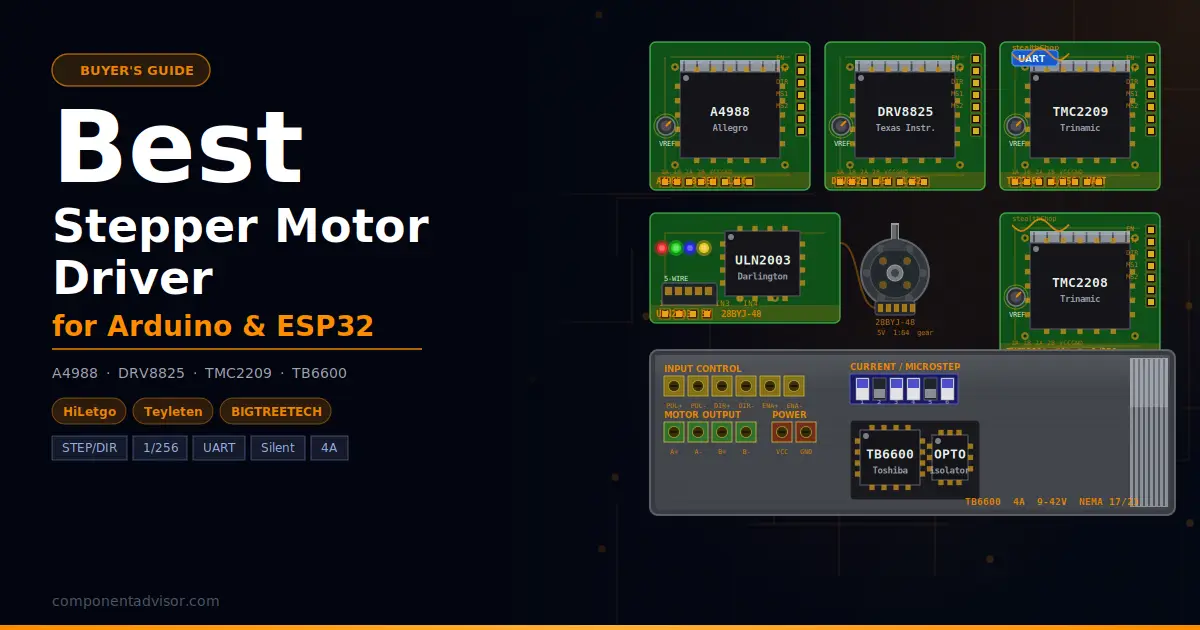
The best stepper motor driver for Arduino and ESP32 depends entirely on what you’re driving. A small 28BYJ-48 gear motor from a starter kit needs a ULN2003 board and runs directly from 5V. A NEMA 17 on a 3D printer needs an A4988 or DRV8825 with current limiting set correctly. A quiet CNC machine or camera slider where noise matters needs a TMC2208 or TMC2209. A router or laser cutter running NEMA 23 motors needs a TB6600. These are different products for different problems, and buying the wrong one wastes time.
This guide covers six stepper motor drivers across the full hobbyist range, from a $9 beginner kit all the way to a 4A high-current driver for NEMA 23 builds. There’s also an educational section at the end covering bipolar vs unipolar motors, microstepping explained, current limiting, and how each chip fits into the broader ecosystem.
Also on ComponentAdvisor: Best DC Motor Driver for Arduino and ESP32 and Best Arduino Sensor Kits
Quick Comparison Table
| Driver | Motor Type | Max Current | Voltage | Microstepping | Best For |
|---|---|---|---|---|---|
| ULN2003 + 28BYJ-48 | Unipolar 5-wire | 500mA | 5V | Half-step | Beginners, starter kits |
| A4988 | Bipolar (NEMA 17) | 2A | 8-35V | 1/16 | Most Arduino stepper projects |
| DRV8825 | Bipolar (NEMA 17) | 2.2A | 8.2-45V | 1/32 | A4988 upgrade, more torque |
| TMC2208 | Bipolar (NEMA 17) | 2A | 4.75-36V | 1/256 | Silent STEP/DIR operation |
| TMC2209 | Bipolar (NEMA 17) | 2A (2.8A peak) | 4.75-29V | 1/256 | Silent + UART + StallGuard |
| TB6600 | Bipolar (NEMA 23) | 4A | 9-42V | 1/32 | High-torque CNC, NEMA 23 |
1. Best for Beginners: HiLetgo ULN2003 + 28BYJ-48 Stepper Motor Kit
HiLetgo 5pcs ULN2003 28BYJ-48 Stepper Motor with Driver Board
Best for: First stepper motor projects, Arduino starter kits, and any build driving a small unipolar gear motor at 5V.

The 28BYJ-48 with its ULN2003 driver board is what most people use for their first stepper motor project. The motor is a small 5V unipolar gear motor with a 1:64 gear reduction, giving it reasonable torque for its tiny size. The ULN2003 driver board takes four Arduino digital pins and drives the motor’s four coils in sequence. No current limiting, no voltage calculations, no heatsink. Connect power and four pins, load the Stepper or AccelStepper library, and the motor turns.
The 5-pack format makes this the sensible buy even if you only need one. These motors find their way into a lot of projects: clocks, small mechanical indicators, pan-tilt camera mounts, valve controls, and antenna rotators. The gear reduction means the motor moves slowly but with enough torque to handle light mechanical loads. One thing to plan around: the 28BYJ-48 is a unipolar motor with five wires, which makes it incompatible with bipolar drivers like the A4988. The ULN2003 is the only driver you should pair it with.
Specifications:
- Motor: 28BYJ-48, 5V unipolar, 4-phase, 5-wire
- Gear ratio: 1:64 (approximately 2048 steps per revolution in half-step mode)
- Driver chip: ULN2003A Darlington array
- Operating voltage: 5V (motor and logic)
- Control pins: 4 Arduino digital pins
- No current limiting required
- Pack: 5 motors + 5 driver boards
Why it stands out:
- Zero setup friction, works at 5V straight from Arduino
- No current limiting or heatsink needed
- More tutorial coverage than almost any other stepper setup
- 5-pack is excellent value for the price
- Compatible with Arduino Stepper and AccelStepper libraries out of the box
Things to keep in mind:
- Unipolar only, not compatible with bipolar drivers
- Slow speed due to gear reduction, not suitable for fast movement
- Low torque compared to NEMA 17 even with gear reduction
- 5-wire connector is specific to this motor family
👉 Buy HiLetgo ULN2003 28BYJ-48 5-Pack on Amazon
Verdict: The right starting point for anyone new to stepper motors. If your project needs precise positioning at low speed and low cost, the 28BYJ-48 with ULN2003 is the simplest path to a working build.
2. Best Overall: HiLetgo A4988 Stepper Motor Driver (5-Pack)
HiLetgo 5pcs A4988 StepStick Stepper Motor Driver with Heat Sink
Best for: NEMA 17 stepper motors, 3D printers, CNC pen plotters, and the majority of Arduino stepper projects that move beyond the 28BYJ-48.

The A4988 is the default stepper driver for hobbyist Arduino projects. It drives bipolar stepper motors like the NEMA 17 using just two pins: STEP and DIR. One pulse on the STEP pin moves the motor one step. Reverse the DIR pin and it goes the other way. That simplicity is why so many tutorials, libraries, and projects use it. The AccelStepper library makes smooth acceleration and deceleration a few lines of code.
The A4988 supports microstepping up to 1/16, meaning each full step can be divided into 16 smaller movements for smoother motion. It includes adjustable current limiting via a small potentiometer on the board, which is the most important setup step: set it correctly before connecting a motor or you risk overheating the driver or stalling the motor. The HiLetgo 5-pack includes heatsinks, worth attaching before first use. At sustained loads above 1A the A4988 gets warm, and the heatsink keeps it in a comfortable operating range.
The A4988 module ships with headers unsoldered on most variants. If you haven’t soldered before, the Beginner’s Guide to PCB Soldering on ArduinoYard covers everything you need.
Specifications:
- Driver chip: A4988 (Allegro)
- Motor type: Bipolar stepper (NEMA 17, NEMA 14, others)
- Max current: 2A per coil (1A without heatsink and forced cooling)
- Motor supply: 8-35V
- Logic supply: 3.3V and 5V compatible
- Microstepping: Full, 1/2, 1/4, 1/8, 1/16
- Interface: STEP/DIR (2 pins)
- Includes heatsinks
Why it stands out:
- Massive tutorial and library support, widest ecosystem of any stepper driver
- Simple two-pin STEP/DIR interface works with any microcontroller
- 3.3V logic compatible, direct connection to ESP32
- 5-pack gives spares for multi-axis builds
- Pololu-standard pinout, compatible with most stepper driver sockets
Things to keep in mind:
- Current limit must be set correctly before connecting a motor
- Audible stepping noise at most speeds
- 1/16 microstepping limit, coarser than TMC drivers
- No stall detection or advanced motion features
- Heatsink attachment recommended before first use
👉 Buy HiLetgo A4988 5-Pack on Amazon
Verdict: The A4988 is the right driver for the vast majority of NEMA 17 projects. The tutorial coverage alone makes it the safest choice for anyone getting started with bipolar stepper motors. Set the current limit before powering up and attach the heatsink, and it will run reliably.
3. Best A4988 Upgrade: Teyleten Robot DRV8825 (5-Pack)
Teyleten Robot DRV8825 Stepper Motor Driver Module with Heat Sink
Best for: NEMA 17 builds needing more current or finer microstepping than the A4988 provides, and as a drop-in replacement in existing A4988 sockets.

The DRV8825 is what you reach for when the A4988 isn’t quite enough. Texas Instruments designed it as a higher-performance bipolar stepper driver with a wider voltage range (8.2V to 45V), higher current capacity (2.2A with cooling), and finer microstepping down to 1/32. The pinout is compatible with A4988 sockets on most breakout boards and RAMPS boards, making it a direct upgrade on existing hardware. One wiring note: the A4988 and DRV8825 have their motor connections swapped. If you drop a DRV8825 into an A4988 socket, rotate it 180 degrees or reverse the motor coil connections, otherwise the motor runs in the opposite direction.
The 1/32 microstepping makes motion noticeably smoother than the A4988’s 1/16 ceiling, which matters on camera sliders or precise linear stages where vibration and step noise affect the output. The DRV8825 also has a dedicated FAULT pin that pulls low if something goes wrong, useful for builds where monitoring driver health in firmware is important.
Specifications:
- Driver chip: DRV8825 (Texas Instruments)
- Motor type: Bipolar stepper
- Max current: 2.2A per coil with sufficient cooling
- Motor supply: 8.2-45V
- Logic supply: 3.3V and 5V compatible
- Microstepping: Full, 1/2, 1/4, 1/8, 1/16, 1/32
- Interface: STEP/DIR
- FAULT output pin
- Includes heatsinks
Why it stands out:
- Drop-in compatible with A4988 sockets (check orientation)
- 1/32 microstepping for smoother motion than A4988
- Higher voltage ceiling (45V vs 35V), better spike protection
- FAULT pin for error detection in firmware
- Higher current headroom for demanding motors
Things to keep in mind:
- Motor direction may be reversed when swapping from A4988, check orientation
- SLEEP pin not pulled up by default, connect to RESET or pull high in code
- Still produces audible stepping noise, not a silent driver
- Current limit potentiometer position differs from A4988, recalibrate when swapping
👉 Buy Teyleten DRV8825 5-Pack on Amazon
Verdict: A worthwhile upgrade from the A4988 for any build that needs more current, higher voltage tolerance, or finer microstepping. The drop-in compatibility makes upgrading an existing build easy, as long as you account for the orientation and SLEEP pin differences.
4. Best Silent STEP/DIR Driver: TMC2208 Stepper Motor Driver (5-Pack)
TMC2208 Stepper Motor Driver Module (5-Pack)
Best for: Quiet stepper operation via STEP/DIR, 3D printers upgrading from A4988 noise, and any build where motor sound is a problem.

Trinamic’s TMC2208 changed what hobbyists expect from stepper drivers. Where the A4988 produces a recognisable buzzing or whining at most speeds, the TMC2208 runs nearly silently using stealthChop2 technology: a voltage-mode control system that drives the motor coils in a way that dramatically reduces audible noise. The difference on a 3D printer or CNC machine is immediately obvious. It also supports up to 1/256 microstepping via internal interpolation, making motion significantly smoother even when commanded in coarser steps.
The TMC2208 runs in STEP/DIR mode without any UART configuration, which means it drops into most A4988 and DRV8825 sockets and works immediately with existing firmware. That’s its main advantage over the TMC2209: simpler setup for most use cases. For projects where you don’t need UART tuning, sensorless homing, or advanced diagnostics, the TMC2208 gives you silent operation without added complexity. Current setting is done via the onboard potentiometer the same way as the A4988 and DRV8825.
Specifications:
- Driver chip: TMC2208 (Trinamic / Analog Devices)
- Motor type: Bipolar stepper
- Max current: 2A RMS (2.8A peak)
- Motor supply: 4.75-36V
- Logic supply: 3.3V and 5V compatible
- Microstepping: Up to 1/256 (via internal interpolation)
- Interface: STEP/DIR (UART also available for advanced config)
- stealthChop2 silent operation
Why it stands out:
- Near-silent operation compared to A4988 and DRV8825
- 1/256 microstepping interpolation for smooth motion
- STEP/DIR compatible, drops into A4988 sockets with no firmware changes
- Lower vibration reduces wear on mechanical components
- 5-pack covers multi-axis builds at good value
Things to keep in mind:
- Runs warmer than A4988 at similar currents, heatsink recommended
- UART configuration possible but requires extra setup if needed
- No StallGuard sensorless homing (that’s the TMC2209)
- Motor direction may differ from A4988 depending on module variant
👉 Buy TMC2208 Stepper Driver 5-Pack on Amazon
Verdict: The right choice when stepper noise is the main problem to solve. If you’re upgrading a 3D printer from A4988 drivers or building anything where quiet operation matters, the TMC2208 in STEP/DIR mode is the cleanest upgrade path.
5. Best Advanced Silent Driver: BIGTREETECH TMC2209 V1.3 (2-Pack)
BIGTREETECH TMC2209 V1.3 Silent Stepper Motor Driver
Best for: Klipper and Marlin 3D printers, sensorless homing builds, advanced CNC controllers, and projects that benefit from UART configuration and StallGuard.

The TMC2209 is Trinamic’s current flagship hobbyist stepper driver and the default choice in most modern 3D printer builds. It has everything the TMC2208 offers plus StallGuard4 sensorless stall detection, which lets you detect when a motor has stalled without a physical end-stop switch. In a 3D printer running Klipper or Marlin, this means sensorless homing: the printer homes its axes by running into the frame until the driver detects the stall, eliminating the need for end-stop switches entirely.
UART communication is the other key feature. Instead of setting current via a potentiometer, you configure the TMC2209 over a single serial wire from the microcontroller, setting exact current values, switching between stealthChop and spreadCycle modes, enabling CoolStep automatic current reduction at lower loads, and reading diagnostics back from the driver. BIGTREETECH is the most trusted brand for TMC driver modules: their V1.3 revision has improved thermal performance and is widely used in Voron and other precision builds.
For ESP32-based stepper control with precise PWM step generation, the ESP32 LEDC PWM guide on ArduinoYard covers how to configure the ESP32’s hardware timer for generating clean step pulses.
Specifications:
- Driver chip: TMC2209 (Trinamic / Analog Devices)
- Motor type: Bipolar stepper
- Max current: 2A RMS (2.8A peak)
- Motor supply: 4.75-29V
- Logic supply: 3.3V and 5V compatible
- Microstepping: Up to 1/256 (interpolation)
- Interface: STEP/DIR + UART single-wire
- stealthChop2 + spreadCycle + StallGuard4 + CoolStep
- Pack: 2 drivers
Why it stands out:
- StallGuard4 enables sensorless homing, no end-stop switches needed
- UART configuration for precise current control and mode switching
- CoolStep reduces current at low loads, saving power and reducing heat
- BIGTREETECH V1.3 has improved thermal management over earlier versions
- Standard choice for Klipper-based 3D printer builds
Things to keep in mind:
- UART wiring and firmware configuration required to use advanced features
- In pure STEP/DIR mode it works like a TMC2208, UART needed for StallGuard
- Lower max motor voltage than DRV8825 (29V vs 45V)
- 2-pack only, higher per-unit cost than A4988 or DRV8825 packs
👉 Buy BIGTREETECH TMC2209 V1.3 2-Pack on Amazon
Verdict: The best stepper driver if you need UART configurability, silent operation, and sensorless homing in the same package. For Klipper builds and advanced motion control projects, the TMC2209 is the right chip. For simpler builds that just need quiet running, the TMC2208 is the more accessible option.
6. Best for NEMA 23 and High-Current Builds: TB6600 Stepper Motor Driver
TB6600 Stepper Motor Driver Controller (4A, 9-42V)
Best for: NEMA 23 stepper motors, CNC routers, laser cutters, and any build where NEMA 17 drivers don’t provide enough current or torque.
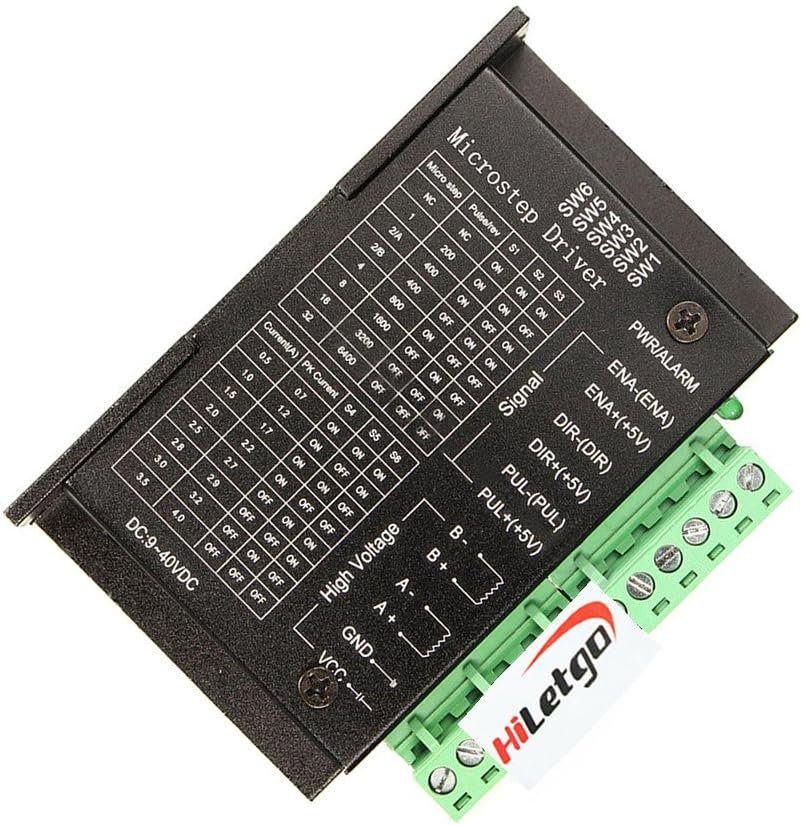
The TB6600 is a different class of driver from everything else in this guide. Where the A4988 and TMC drivers are tiny StepStick-format modules designed to plug into printer boards and breadboards, the TB6600 is a standalone enclosed driver with screw terminals, DIP switches, and a metal enclosure for heat dissipation. It drives bipolar stepper motors at up to 4A continuous and 42V, which puts NEMA 23 motors firmly within range.
The interface is still simple STEP/DIR, so Arduino or ESP32 control code is identical to what you’d write for an A4988. You connect STEP, DIR, and EN signals to the Arduino, connect motor coils to the screw terminals, connect a 12V-24V power supply, and set current and microstepping via the DIP switches on the side. The TB6600 is optically isolated: the control signals from your microcontroller are electrically separated from the high-voltage motor supply, which protects your Arduino or ESP32 from noise and voltage spikes generated by the motor.
For CNC routers, laser engravers, and other builds running NEMA 23 motors from a 24V supply, the TB6600 is the standard starting point before stepping up to industrial closed-loop drivers.
Specifications:
- Driver chip: TB6600 (Toshiba)
- Motor type: Bipolar stepper (NEMA 17, NEMA 23)
- Max current: 4A continuous
- Motor supply: 9-42V
- Logic supply: 3.3V and 5V (optically isolated)
- Microstepping: Full, 1/2, 1/4, 1/8, 1/16, 1/32 (DIP switch)
- Interface: STEP/DIR (optically isolated)
- Enclosed metal housing with heatsink
- DIP switch current and microstepping configuration
Why it stands out:
- Handles NEMA 23 motors that exceed the current limits of StepStick-format drivers
- Optical isolation protects Arduino and ESP32 from motor noise
- Enclosed housing provides passive cooling without an external heatsink
- DIP switch configuration, no potentiometer adjustment needed
- Same STEP/DIR interface as A4988, no code changes needed
Things to keep in mind:
- Larger physical footprint, not breadboard-compatible
- DIP switch current settings are fixed steps, not continuously adjustable
- No microstepping interpolation or silent operation
- Overkill for NEMA 17 builds that work fine with an A4988 or DRV8825
👉 Buy TB6600 Stepper Motor Driver on Amazon
Verdict: The correct choice when your motor exceeds what an A4988 or DRV8825 can drive. For NEMA 23 CNC and laser builds from a 12V-24V supply, the TB6600 gives you the current capacity and optical isolation that StepStick-format drivers can’t provide.
Which Stepper Motor Driver Should You Buy?
Start with what motor you’re using. For the 28BYJ-48 that comes with most Arduino starter kits, the ULN2003 board is the only driver that works: it’s a unipolar motor and none of the bipolar drivers in this guide will run it. For NEMA 17, the A4988 is the default choice for a first build. The tutorial support alone makes it worth starting here even if you later upgrade.
If you’re upgrading an existing A4988 build and need more current or smoother motion, the DRV8825 drops into the same socket and adds 1/32 microstepping and better voltage tolerance. If the noise from the A4988 or DRV8825 is a problem, the TMC2208 in STEP/DIR mode is the simplest upgrade path to near-silent operation with no firmware changes.
For builds running Klipper, needing sensorless homing, or wanting precise UART current control, the BIGTREETECH TMC2209 is the right chip. It does everything the TMC2208 does and adds StallGuard and UART tunability. For NEMA 23 motors and CNC or laser builds running from 12V-24V supplies, skip the StepStick-format drivers entirely and use the TB6600.
Stepper Motor Basics: What to Know Before Wiring
Bipolar vs unipolar: Most stepper motors in Arduino projects are bipolar. They have four wires forming two coils, and the driver alternates current direction through each coil to rotate the shaft. The A4988, DRV8825, TMC2208, TMC2209, and TB6600 all drive bipolar motors. The 28BYJ-48 is a unipolar motor with five wires and a different internal configuration. It needs the ULN2003 driver and isn’t compatible with bipolar drivers.
Microstepping: A full step rotates the motor shaft by its natural step angle, typically 1.8 degrees on a NEMA 17 (200 steps per revolution). Microstepping divides each full step into smaller increments, making motion smoother and reducing vibration. An A4988 at 1/16 gives 3200 steps per revolution. A TMC2208 at 1/256 interpolation gives 51200. Higher microstepping doesn’t increase torque: at fine microstep settings torque per step is lower, but overall motion quality improves significantly for applications where smoothness matters.
Current limiting: Every bipolar stepper driver in this guide has a current limit that must be set before use. Set it too low and the motor lacks torque or stalls. Set it too high and the motor and driver overheat. For the A4988 and DRV8825, current is set by measuring the reference voltage on the potentiometer and applying a formula from the datasheet. For the TMC2208 and TMC2209, current is set the same way in STEP/DIR mode, or precisely over UART. For the TB6600, current is set via DIP switches to predefined levels.
STEP/DIR interface: Every driver in this guide uses STEP and DIR signals from the microcontroller. One pulse on STEP moves the motor one microstep. The DIR pin sets direction. This means the same two-line control code works for all of them, from the A4988 to the TB6600. Speed is determined by pulse frequency. Libraries like AccelStepper handle acceleration profiles automatically.
Motor supply voltage: Higher supply voltage generally means more torque at higher speeds because current can ramp up faster in the motor coils. Running a NEMA 17 from 12V gives significantly more high-speed torque than running it from 5V. Always use a separate power supply for the motor, never draw motor current from the Arduino’s 5V or 3.3V pins.
Final Recommendation
For most Arduino and ESP32 stepper projects, the HiLetgo A4988 5-pack is the right starting point: two-pin control, proven library support, and enough current for any NEMA 17. When noise becomes a problem, the TMC2208 is the cleanest upgrade. For advanced builds with Klipper or sensorless homing requirements, go straight to the BIGTREETECH TMC2209. For NEMA 23 and CNC work, the TB6600 is the only option that makes sense.
For brushed DC motor control rather than stepper motors, the Best DC Motor Driver for Arduino and ESP32 covers the L298N, TB6612FNG, and BTS7960. For generating clean step pulses on the ESP32, ESP32 LEDC PWM on ArduinoYard covers hardware timer configuration for smooth motion control.
Related on ComponentAdvisor: Best DC Motor Driver for Arduino and ESP32 · Best Arduino Sensor Kits · Best Breadboard and Jumper Wire Kit · Best Soldering Kits for Beginners
1 thought on “Best Stepper Motor Driver for Arduino and ESP32”