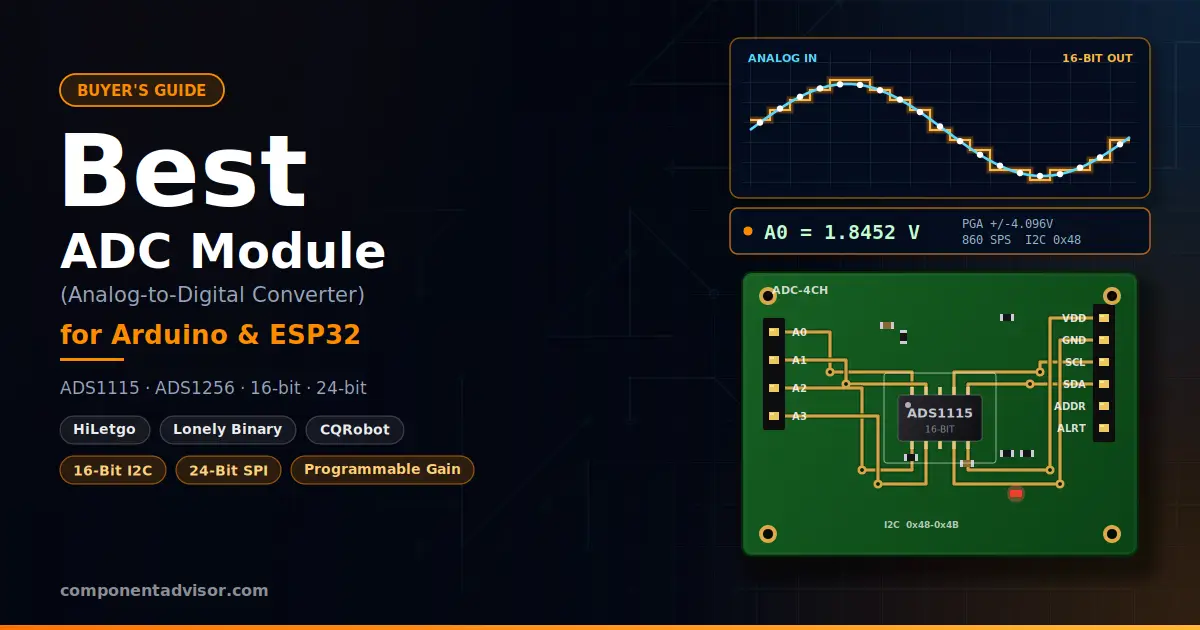
Choosing the best ADC module for Arduino starts with an uncomfortable fact: the analog inputs already on your board are often the weakest link in your measurement chain. An Arduino Uno reads analog voltages with only 10-bit resolution, and the ESP32’s built-in converter is 12-bit but has quirks that catch many beginners out. If you want clean readings from a battery, a thermistor, a load cell or a small sensor signal, an external ADC module is the simplest fix.
An ADC (analog-to-digital converter) module turns a voltage into a number your microcontroller can read, and it does so with its own reference, its own amplifier and a much finer scale. Most hobby boards in this category use the TI ADS1115, a 16-bit converter that talks over I2C, so it needs only two data pins no matter how many channels you read. For serious precision there is also the ADS1256, a 24-bit SPI converter.
This guide covers four boards: three ADS1115 variants (a value multi-pack, an ESP32-friendly multi-pack and one with a built-in thermistor) plus a 24-bit ADS1256 board. We left out bare chips and Raspberry Pi HATs, since neither is a plug-and-play choice for Arduino and ESP32 builds.
Planning the rest of your build? See our guides to the best Arduino sensor kit and the best ESP32 development boards.
Quick Comparison Table
| Model | Resolution | Inputs | Interface | Standout Feature | Best For |
|---|---|---|---|---|---|
| HiLetgo ADS1115 (3-pack) | 16-bit | 4 single-ended or 2 differential | I2C | Programmable gain amplifier, pack of three | Everyday precision on a budget |
| Lonely Binary ADS1115 (3-pack) | 16-bit | 4 single-ended or 2 differential | I2C | 2.0 to 5.5V range, four selectable addresses | ESP32 and Arduino projects with several boards |
| CQRobot ADS1115 | 16-bit | 4 single-ended or 2 differential | I2C | Onboard MF52AT NTC thermistor | Temperature plus analog sensing in one board |
| HiLetgo ADS1256 | 24-bit | 8 single-ended or 4 differential | SPI | 30 ksps, 2.5V onboard reference | Low-noise, high-precision measurement |
1. Best Value ADS1115: HiLetgo ADS1115 3-Pack
HiLetgo 3pcs ADS1115 16 Bit 4 Channel I2C ADC Module
Best for: Anyone who wants proven 16-bit readings at the lowest cost per board.

HiLetgo’s ADS1115 is the default starting point for most hobbyists. The listing covers a pack of three 4-channel, 16-bit I2C boards with a programmable gain amplifier (PGA), which lets you match the input range to your signal. The ADS1115 chip itself supports up to 860 samples per second, and it can read four single-ended inputs or two differential pairs.
A pack of three is useful in practice. You can keep a spare, put one board on each of several projects, or chain boards on one I2C bus, since the ADS1115 supports four addresses. For an Uno or an ESP32 reading a few analog sensors, this is the board that makes the most sense.
Specifications:
- Chip: ADS1115, 16-bit resolution
- Inputs: 4 single-ended or 2 differential
- Interface: I2C, with a programmable gain amplifier
- Pack: 3 boards (per the listing title)
- Chip supply range: 2.0 to 5.5V per the ADS1115 datasheet
Why it stands out:
- Sixteen-bit resolution is a big step up from the Uno’s 10-bit input
- The programmable gain amplifier lets you read small signals with finer steps
- Works with 3.3V or 5V logic, so it suits Uno and ESP32 boards alike
- Only two data pins are needed, however many channels you read
- A three-pack gives you spares or lets you build a multi-board setup
Things to keep in mind:
- The four channels share one converter, so scanning all of them divides the available sample rate
- Documentation comes from the chip datasheet and community libraries rather than a manufacturer guide
- Check whether the pin headers are pre-soldered if you would rather not solder
👉 Buy HiLetgo ADS1115 3-Pack on Amazon
Verdict: The sensible default. It gives you the ADS1115’s full feature set at a low price per board, and the three-pack is handy once you start building more than one project.
2. Best Multi-Pack for ESP32: Lonely Binary ADS1115 3-Pack
Lonely Binary 3-Pack ADS1115 16-Bit ADC I2C for ESP32 & Arduino IDE
Best for: ESP32 and Arduino builders who want several boards and clear spec details in the listing.

This is another three-pack of ADS1115 boards, aimed squarely at ESP32 and Arduino IDE users. The listing calls out a 2.0 to 5.5V supply range with no level shifter needed, 860 samples per second, and a programmable gain stage covering up to 6.144V. It also highlights four selectable I2C addresses, so several boards can share one bus.
That address feature matters more than it sounds. With four boards you can read up to 16 single-ended channels over just two wires, which is a neat way to scale a sensor project without changing microcontrollers. The ESP32’s own ADC is a poor fit for that sort of work, which is where a board like this earns its place.
Specifications:
- Chip: ADS1115, 16-bit
- Supply: 2.0 to 5.5V, no level shifter needed per the listing
- Sample rate: up to 860 SPS
- Gain range: PGA up to 6.144V per the listing
- Addressing: four selectable I2C addresses, up to four boards on one bus
- Pack: 3 boards
Why it stands out:
- The listing is clear about voltage range, sample rate and addressing
- Wide supply range suits both 3.3V ESP32 boards and 5V Arduinos
- Four addresses let you scale up to 16 single-ended channels
- Marketed for the Arduino IDE, which helps beginners find libraries
Things to keep in mind:
- A 6.144V gain setting does not mean you can measure 6V on a 3.3V supply, because inputs must stay within the supply rail
- It is a less established brand than HiLetgo, so read recent buyer reviews before ordering
- You will still need to wire address pins yourself when using more than one board
👉 Buy Lonely Binary ADS1115 3-Pack on Amazon
Verdict: A good alternative to the HiLetgo pack if you like the clearer listing details or plan to build a multi-board setup. Just respect the input limits.
3. Best With Built-In Thermistor: CQRobot ADS1115
CQRobot ADS1115 4-Channel 16-Bit ADC Converter
Best for: Projects that need precision analog inputs plus a quick temperature reading on the same board.

CQRobot’s board uses the same ADS1115 core as the others, with programmable gain and a selectable I2C address, but it adds an onboard MF52AT NTC thermistor for temperature measurement. That makes it handy for logging jobs where you want a sensor reading and the ambient temperature around the board without wiring a separate part.
It is sold as a single board rather than a pack, so it costs more per unit than the multi-packs. What you are paying for is the extra convenience of that built-in thermistor.
Specifications:
- Chip: ADS1115, 16-bit, 4 channels
- Gain: programmable, per the listing
- Addressing: selectable I2C address
- Extra: onboard MF52AT NTC thermistor for temperature measurement
- Marketed for Arduino and Raspberry Pi
Why it stands out:
- Built-in thermistor saves a separate temperature sensor
- Same 16-bit ADS1115 performance as the cheaper boards
- Selectable address makes multi-board setups possible
- Single-board listing is easy to match to a specific project
Things to keep in mind:
- Check the listing or manufacturer documentation for which input the thermistor uses and its nominal resistance before relying on it
- NTC thermistors need a conversion formula such as Steinhart-Hart for good accuracy
- It is a single board, so there is no spare as there is in the three-packs
👉 Buy CQRobot ADS1115 on Amazon
Verdict: Pick this one if the thermistor fits your project, such as a small data logger. If you only need analog inputs, the multi-packs are better value.
4. Best Precision Pick: HiLetgo ADS1256 24-Bit 8-Channel
HiLetgo ADS1256 5V 8 Channel 24 Bit ADC Data Acquisition Board Module
Best for: Low-noise measurement jobs such as load cells, strain gauges and precision sensors.

The ADS1256 is a different class of converter. It is a 24-bit delta-sigma part with eight single-ended inputs or four differential pairs, and the module adds an ADR03 2.5V reference chip. The listing quotes data rates up to 30 ksps and a nonlinearity of about 0.0010%, which is far beyond what the ADS1115 offers for this kind of work.
That precision comes with extra effort. The ADS1256 uses SPI plus a data-ready line, so it takes more wiring and more code than an I2C board. It is best for people who already know why they need it.
Specifications:
- Chip: TI ADS1256IDB, 24-bit delta-sigma
- Inputs: 8 single-ended or 4 differential
- Interface: SPI (with a data-ready pin)
- Data rate: up to 30 ksps per the listing
- Reference: onboard ADR03 2.5V
- Nonlinearity: about 0.0010% per the listing
Why it stands out:
- Far higher resolution and lower noise than 16-bit boards
- Eight inputs on a single board
- Onboard precision reference chip
- A good fit for load cell and sensor amplifier projects
Things to keep in mind:
- The listing says the module suits measuring analog voltage within 3V, so plan dividers or amplifiers for anything higher
- It is sold as a 5V module, so check the logic levels before connecting it to a 3.3V ESP32
- Noise-free resolution is lower than 24 bits and drops as the data rate rises, so do not expect a full 24 bits of clean readings
👉 Buy HiLetgo ADS1256 on Amazon
Verdict: The right board when 16 bits is not enough. For most hobby projects the ADS1115 is easier and cheaper, so only choose this if you have a clear precision requirement.
Which ADC Module for Arduino Should You Buy?
For most people shopping for an ADC module for Arduino, the HiLetgo ADS1115 three-pack is the answer. It adds 16-bit resolution and a programmable gain stage over I2C, it works at 3.3V or 5V, and the pack gives you spares for future projects. If you build with ESP32 boards and like detailed listing information, the Lonely Binary pack is a close alternative, and the choice between them largely comes down to brand preference.
Choose the CQRobot board if temperature sensing is part of your project. A built-in thermistor is a small convenience, but for a compact logger it saves a part and a few wires. Just confirm how it is wired before you rely on it.
The HiLetgo ADS1256 is for a narrower group. If you are reading a load cell, a strain gauge or a low-level sensor and you can show that 16 bits is not enough, it is the best choice here. If you cannot, skip it, because you will spend more time on SPI wiring and signal conditioning than on your actual project.
One honest note: if you only need to read a couple of analog sensors on an Uno, you may not need any of these. The built-in input is fine for a potentiometer or a rough light reading. An external ADC earns its place when accuracy, noise or the ESP32’s limitations start to matter.
Why Add an External ADC? Arduino and ESP32 Limits
The Arduino Uno has six analog inputs and a 10-bit converter, which gives 1,024 steps across 0 to 5V. That is roughly 4.9 millivolts per step, which is fine for a knob but coarse for a thermistor or a battery fuel gauge. Small changes simply disappear between steps.
The ESP32 has two 12-bit converters, but there are catches. Espressif’s documentation notes that the second converter (ADC2) is used by the Wi-Fi driver, so it can only be used when Wi-Fi has not started. The documentation also recommends keeping inputs within roughly 0.15 to 2.45V at the highest attenuation setting if you want the best accuracy, and it suggests using the calibration functions. Together these limits make the built-in ADC awkward for projects that need Wi-Fi and accurate readings at the same time.
An external converter sidesteps both problems. It has its own reference, its own gain stage and its own resolution, and it frees your microcontroller’s pins for other jobs. The cost is a little extra wiring and a library.
ADS1115 Gain, Resolution and Input Limits
The ADS1115’s programmable gain amplifier sets the full-scale range, and a smaller range means finer steps. These are the standard ranges from the TI datasheet:
| Full-Scale Range | Step Size (approx.) |
|---|---|
| ±6.144 V | 187.5 µV |
| ±4.096 V | 125 µV |
| ±2.048 V | 62.5 µV |
| ±1.024 V | 31.25 µV |
| ±0.512 V | 15.6 µV |
| ±0.256 V | 7.8 µV |
Two rules save beginners a lot of trouble. First, the gain setting does not change what the chip can safely handle. Input voltages must stay within the supply rail, so on a 3.3V supply you cannot measure 5V directly, whatever range you select. Use a voltage divider for higher voltages. Second, smaller ranges give finer steps but clip larger signals, so pick the smallest range that still covers your signal.
Addressing is simple. The ADS1115 uses one of four I2C addresses, 0x48 to 0x4B, selected by tying its ADDR pin to GND, VDD, SDA or SCL. That is how you run up to four boards on one bus. It can also read a differential pair, which measures the difference between two inputs and helps reject noise common to both wires, a useful trick for bridge sensors.
Final Recommendation
For most builders the HiLetgo ADS1115 three-pack is the pick, because it delivers 16-bit readings over I2C at a low cost per board. If you need temperature sensing on the same board, the CQRobot version makes sense, and if you have a real precision requirement, the HiLetgo ADS1256 is the step up. In every case, the best ADC module for Arduino is the one that matches your signal range and logic level, not the one with the most bits. To get comfortable with analog signals first, try ArduinoYard’s DC voltage sensor guide and LDR guide, then log your readings with its ESP32 microSD data logger.
Keep building: Best Temperature and Humidity Sensor for Arduino, Best Multimeter for Electronics Beginners, Best DC-DC Converter for Arduino and ESP32 and Best Oscilloscopes for Beginners.